Lower Paxton Roofing repairs chimney flashing in Lower Paxton, PA, with more than 20 years of roofing work and service across surrounding cities including Linglestown, Progress, Susquehanna Township, Harrisburg and Hummelstown. Chimneys are one of the most common leak sources we trace, and the cause is almost always the flashing where the masonry meets the roof.
Chimney flashing has a hard job. It seals a rigid masonry structure to a roof that expands, contracts and moves with the seasons, and it does so at the spot where water running down the roof collects. When it fails, water runs down the chimney chase into the attic, the framing and the ceilings around the fireplace.
We repair chimney flashing with metal, properly lapped and set into the masonry, rather than with layers of caulk. Before any work, we check the attic and the chimney itself so the repair targets the real source.
How Chimney Flashing Works
Step Flashing Along the Sides
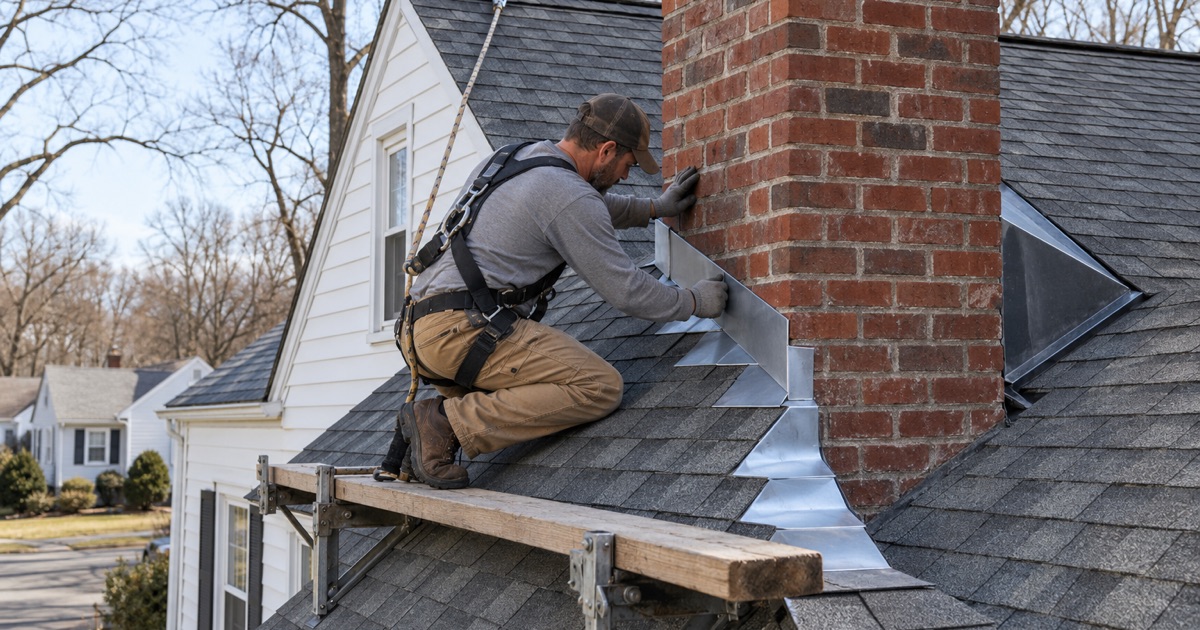
Along the sides of a chimney, step flashing is woven into the shingle courses, one piece per course. Each piece turns up against the brick and lies under the shingle above, so water running down the roof is directed over it rather than behind it. When step flashing rusts through or was installed as a single long strip, water finds the gap.
Counter Flashing Into the Masonry
Counter flashing covers the top of the step flashing and is set into the chimney itself. On a correct installation, the counter flashing is cut into a mortar joint or a reglet and sealed, so water running down the brick lands on the outside of the step flashing. Counter flashing that is only glued to the face of the brick pulls away within a few seasons.
We cut new reglets or rake out mortar joints, set the counter flashing into them and seal the joint. On stone or irregular chimneys, we shape the counter flashing in steps to follow the courses.
Apron and Back Flashing
At the downhill face, an apron flashing laps over the shingles below the chimney. At the uphill face, back flashing turns up the masonry and runs under the shingles above. The uphill side takes the most water, and a failed back flashing is one of the most common chimney leaks.
We install self-adhering ice and water barrier under all of these pieces, wrapped up onto the masonry, before the metal goes on. If a piece of flashing is ever damaged, that membrane is the layer that keeps water out of the attic until the flashing can be fixed.
Crickets on Wide Chimneys
Why a Cricket Matters
Water running down a roof hits the uphill face of a chimney and has to go somewhere. On a narrow chimney it runs around the sides. On a wide one, water and debris pool against the masonry, and the back flashing sits in standing water every time it rains.
A cricket, sometimes called a saddle, is a small peaked structure built behind the chimney that splits the flow and sends it around both sides. We frame crickets from wood, sheathe them and cover them with ice and water barrier and flashing or shingles to match the roof.
Adding a Cricket to an Existing Roof
Many older chimneys were built without crickets. Adding one during a flashing repair or a roof replacement is often the most effective way to stop a chronic leak at the back of the chimney. The scope lists the cricket as its own line so you can see what it adds.
Signs of Chimney Flashing Failure
Stains, Drips and Damp Framing
A water stain on the ceiling or wall beside the chimney is the classic sign. In the attic, look for darkened framing and damp insulation around the chimney chase. Leaks often show only in certain storms, because wind-driven rain from one direction pushes water under a specific piece of flashing.
Caulk and Roofing Cement
Thick layers of caulk or roofing cement around a chimney usually mean someone has tried to stop a leak without replacing the flashing. Sealants crack in sun and freeze-thaw cycles, and water then runs behind the patch. When we find a chimney covered in patches, we remove them and rebuild the flashing properly.
Rust, Gaps and Loose Metal
Rusted or pitted flashing, counter flashing pulled out of its joint and gaps where the metal meets the brick can often be seen from the ground with binoculars. Loose metal rattles in wind and lets water in at the edges.
The Chimney Itself
Crowns, Mortar and Brick
Not every chimney leak is a flashing failure. A cracked chimney crown lets water into the flue and chase, open mortar joints let water through the masonry, and porous brick absorbs rain. Water entering higher up can appear at the roof line and look like a flashing leak.
We inspect the crown, the mortar and the brick when we inspect the flashing, and tell you which part is failing. Where masonry repair is needed, we explain it so you can have it done by a mason, before or alongside the flashing repair.
Chimney Flashing and a New Roof
Replaced, Not Reused
When we replace a roof, step, counter and chimney flashing is replaced with it, never reused under new shingles. Old flashing was bent to fit the old roof, often rusted where it was hidden, and will not seal properly against new materials. Reusing it to save an hour is how a new roof ends up leaking at the chimney in its first year.
New flashing goes in with self-adhering ice and water barrier around the chimney base, a cricket where the chimney is wide enough to need one and counter flashing set into the masonry. The written scope lists the chimney work as its own item so it can be compared between estimates.
Slate Roofs and Chimneys
On slate roofs, chimney flashing is usually copper or lead-coated, and replacing it means removing and resetting the slates around the chimney. We do this slate by slate with copper nails and slate hooks, so the rest of the roof is not disturbed.
- 20+ Years Roofing
- Itemized Written Scopes
- Repair Before Replace