
Lower Paxton Roofing provides flat roof repair in Lower Paxton, PA, with more than 20 years of roofing work and service across surrounding cities including Linglestown, Progress, Susquehanna Township, Harrisburg and Hummelstown. Most of the flat roofs we repair are not on commercial buildings at all. They sit on houses: rear additions, kitchen bump-outs, porches, sunrooms, attached garages and dormers.
Those small low-slope roofs cause an outsized share of leaks. They often meet a wall, a window or the main roof, and the joint is where water gets in. They also tend to collect years of patches applied by whoever was handy. We find the actual failure, repair it with material that matches the existing membrane, and fix the drainage or flashing that caused it.
You get photos of what failed and a written scope of what we will fix, before the work starts. If a repair will not hold on that roof, the scope says so plainly.
Flat Roof Systems We Repair
EPDM Rubber Roofs
EPDM rubber is the most common membrane on residential additions and porches here. It is durable and flexible, and it usually fails at seams, at the edges and where it turns up a wall. We repair EPDM with cleaned, primed surfaces and compatible seam tape and flashing, which bond chemically to the rubber.
Many failed EPDM repairs we see were made with asphalt roofing cement. It does not bond to rubber, so water runs underneath the patch and keeps leaking into the addition below.
TPO and PVC Membranes
TPO and PVC single-ply membranes have heat-welded seams. They appear on newer additions, on some porches and on many commercial buildings. A TPO or PVC repair is a welded patch of the same material, applied with a hot-air welder, then probed to confirm the seam has fused.
Torch-Down Modified Bitumen and Older Built-Up Roofs
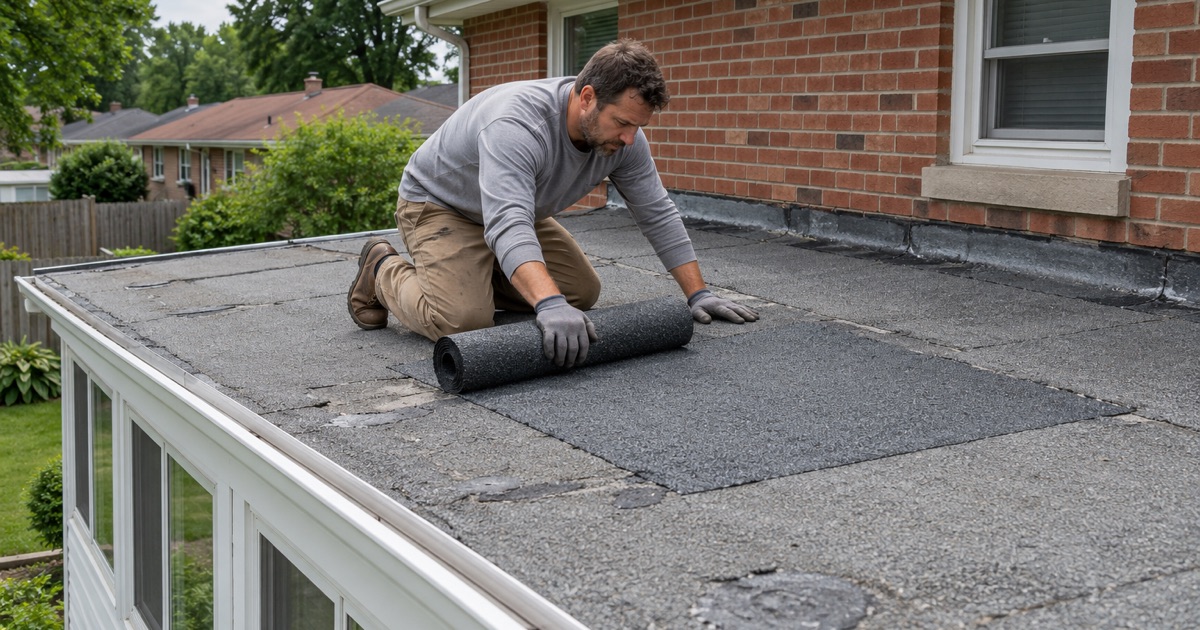
Torch-down SBS and APP modified bitumen has a granulated cap sheet and is common on rowhouse rear roofs, porches and older additions. Repairs involve cutting out damaged areas and fusing new cap sheet over them with proper laps. Some older houses still have built-up tar-and-gravel roofs, which need compatible bitumen materials or, more often, replacement with a modern membrane.
Where Flat Roofs Fail
The Wall Joint
The point where a flat roof meets the wall of the house is the most common leak we find. The membrane has to turn up the wall and be covered by counter flashing or the siding above, so water running down the wall lands on the roof rather than behind it. On many additions the membrane simply stops at the wall with a bead of sealant.
We rebuild that joint properly: membrane turned up the wall, terminated with a bar, and covered with counter flashing or reglet-set metal. On brick walls the counter flashing is cut into the mortar joint.
Edges, Drip Edge and Gutters
At the open edges, the membrane needs edge metal or a drip edge so water drops cleanly into the gutter. Edges that have shrunk back, pulled loose or lost their metal let water run into the fascia and the wall below. We replace edge metal, secure the membrane and make sure the gutter is positioned to catch what the roof sheds.
Ponding Water
A flat roof is never truly flat; it needs a slight slope to drain. When framing settles or the roof was built dead level, water sits in the low spots after every rain. Ponding water ages the membrane, adds weight and finds any weakness in a seam. We identify low spots and, where needed, build in tapered insulation or crickets to move water to the edge or a drain.
Penetrations and Skylights
Vent pipes, exhaust fans and skylights through a flat roof need flashing made for that membrane. Pitch pans filled with sealant and generic boots fail sooner than proper prefabricated boots and membrane flashing. We replace those details in kind with the existing roof.
Skylights on flat roofs deserve a closer look than most. A skylight set on a low curb sits in the path of standing water, so we check the curb height and, where it is too low, raise it during the repair so the flashing sits above the water line instead of in it.
Our Approach to Flat Roof Repairs
Find the Wet Area First
Water can travel a long way under a flat roof membrane before it shows inside. We look at the ceiling below, inspect the roof surface for splits, blisters and open seams, and probe for soft or wet areas. Where insulation sits under the membrane, wet insulation has to be cut out and replaced or it will keep the deck damp.
On small roofs with no insulation, we check the decking from below where the ceiling allows, or at the edges once the membrane is opened. Soft decking under a flat roof is photographed and shown to you before it is replaced, at a per-sheet price set in the scope.
Repair in Kind
Each repair uses the same membrane family as the existing roof, so the patch bonds and moves with the roof around it. We remove old failed patches where they are holding water rather than adding another layer on top. The written scope says which material we will use and why.
If we cannot tell what the existing membrane is from the surface, we take a small sample at an edge. Guessing wrong between EPDM and a coated modified bitumen, for example, leads straight to a patch that peels off in the first summer.
Repair or Replace
We give you a straight answer on whether a repair will hold. If the membrane is cracked across its surface, covered in old patches or holding water under large areas, we explain that replacement is the better value and show you the evidence.
If replacement is the answer, the flat section can often be done alongside other roof work, sharing the same crew and dumpster. Lower Paxton Township’s permit chart says roof work needs a building permit only when structural changes are made, and we check the rule for your municipality before pricing.
- 20+ Years Roofing
- Itemized Written Scopes
- Repair Before Replace