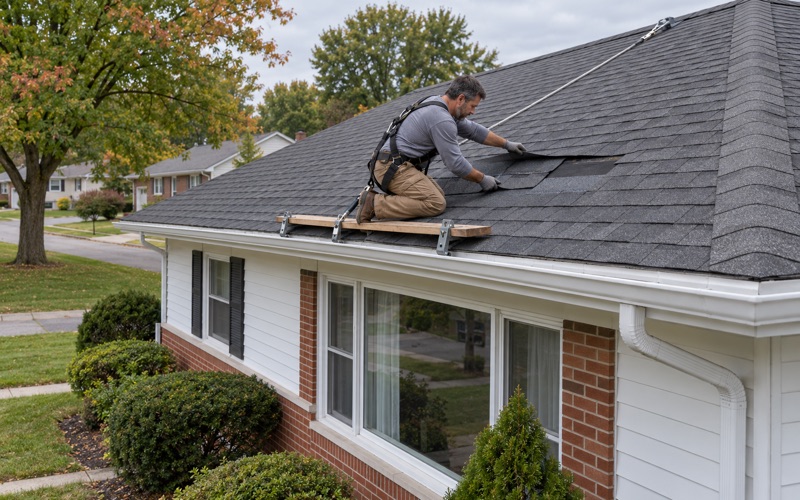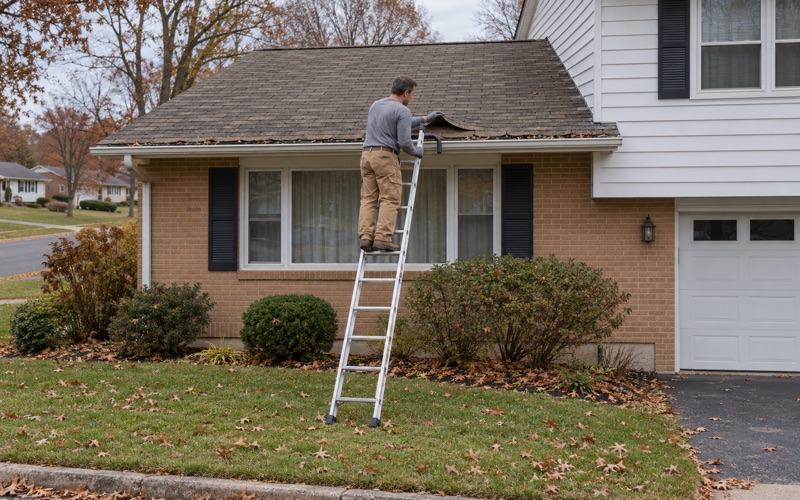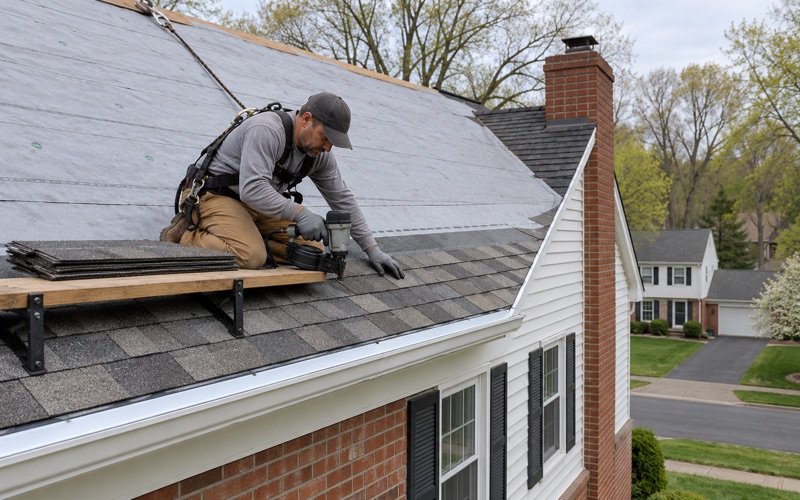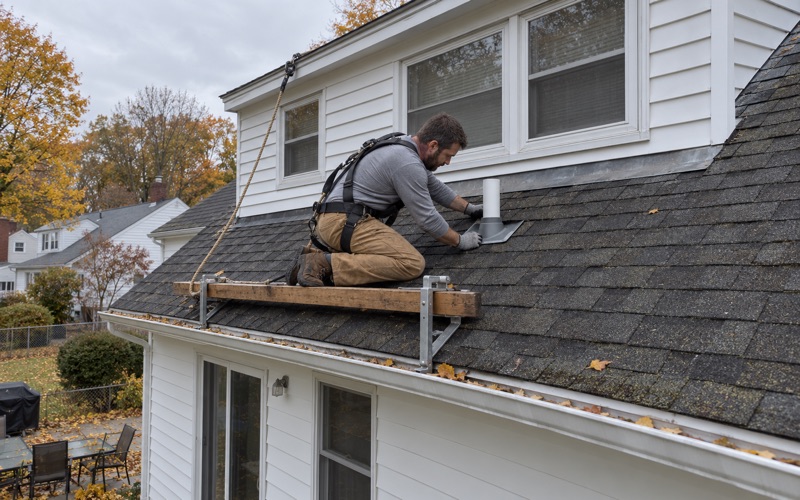
Lower Paxton Roofing has spent more than 20 years on roofing in Linglestown and the rest of the township, and most of what we do here is re-roofing and repairing detached family houses. We start every job by deciding whether the roof actually needs replacing. If a section of flashing or a run of shingles is the real problem, we say so plainly before replacement ever comes up.
When a leak brings us out, we go into the attic as well as onto the roof. Water rarely shows up on a ceiling directly below the spot where it gets in, so we follow the stain back along the rafters and sheathing until we find the entry point. Only then do we put a price on the fix.
Our written estimates break the work into separate lines for tear-off, decking, underlayment, flashing, ventilation and gutters. That way an owner holding two bids can compare them item by item instead of guessing what a single lump sum covers. Nothing gets bundled into an allowance the owner cannot see.
From a 1765 Village to a 1950s Suburb
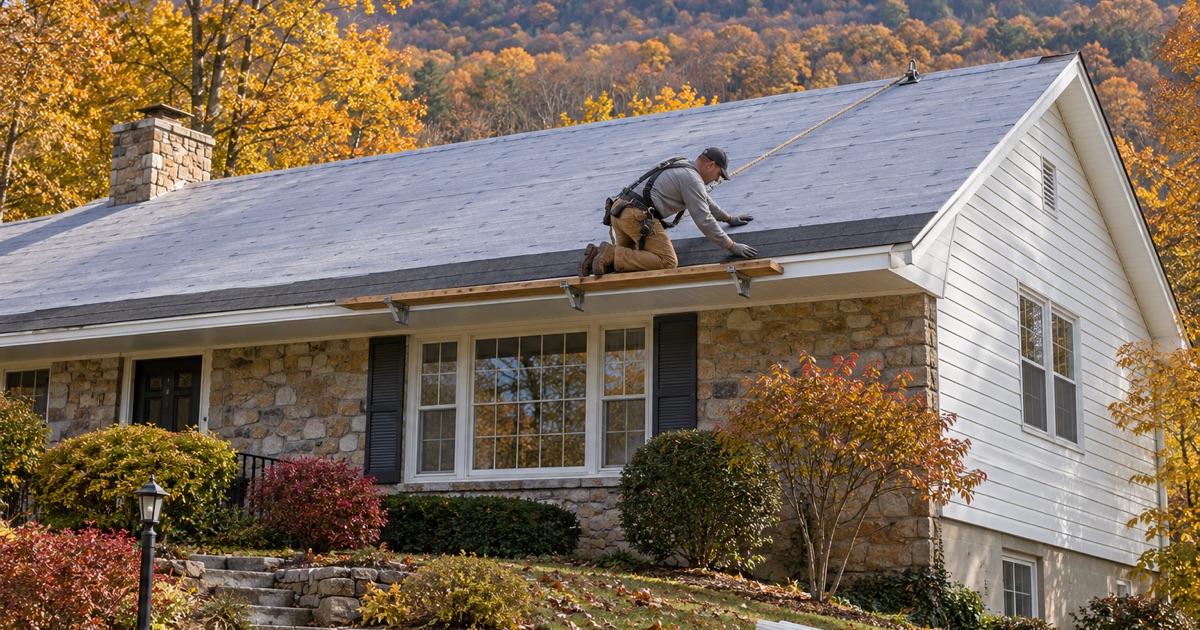
Linglestown is older than most of the houses in it. The village dates to the colonial era, but the roofs we work on mostly belong to the postwar decades, and that gap shapes almost every estimate we write here.
Thomas Lingle’s 80 Lots
Thomas Lingle laid out 80 lots in 1765 and named the place the Town of Saint Thomas. Residents called it Lingle’s town, and after his death in 1811 that name stuck unofficially. The plan centered on a public square, with lots on the square drawn shorter and set back to leave room for commercial activity.
Today the village is a cluster of homes, churches and businesses where Route 39 meets Colonial Road. It is a census-designated place inside Lower Paxton Township, not a borough or a township of its own, which matters later when we talk about who has authority over a re-roof.
The Postwar Build-Out
The housing stock tells a different story than the founding date. According to the Census Bureau’s 2024 five-year estimates, 916 of the 2,804 homes in the Linglestown CDP were built during the 1950s, while only 152 date to 1939 or earlier. The 1950s decade alone produced roughly a third of everything standing.
That means the typical roof we tear off here is on a house built after the war, not on a colonial storefront. A roof on a house that age is rarely its first, and each earlier round of work leaves its own layer of decisions, good and bad, for the next crew to uncover.
Detached, Owner-Occupied Houses
Of those 2,804 homes, 2,467 are detached single-family houses, about 88 percent. Owners occupy 2,314 of the 2,768 occupied units. In practice that means most of our Linglestown calls come from the person who lives under the roof and has a stake in how long it lasts.
An owner-occupant tends to ask longer-term questions: how many years a shingle line should last, whether the ventilation is right, whether the gutters are sized for the roof. We answer those questions in the estimate itself rather than leaving them for the day the crew arrives.
Looking for roofing closer to Progress? See Roofing Services in Progress.
Re-Roofing Linglestown’s 1950s Houses
A house from the 1950s carries roofing details that newer construction does not. We plan for them up front, so the estimate an owner signs already accounts for what the old shingles are likely to reveal.
What Turns Up Under the Old Shingles
On postwar houses we often find more than one layer of old shingles, and sometimes board sheathing rather than plywood. Any damaged decking we uncover is photographed and shown to the owner before it is replaced. The per-sheet price for that replacement is set in the contract, so there is no surprise charge.
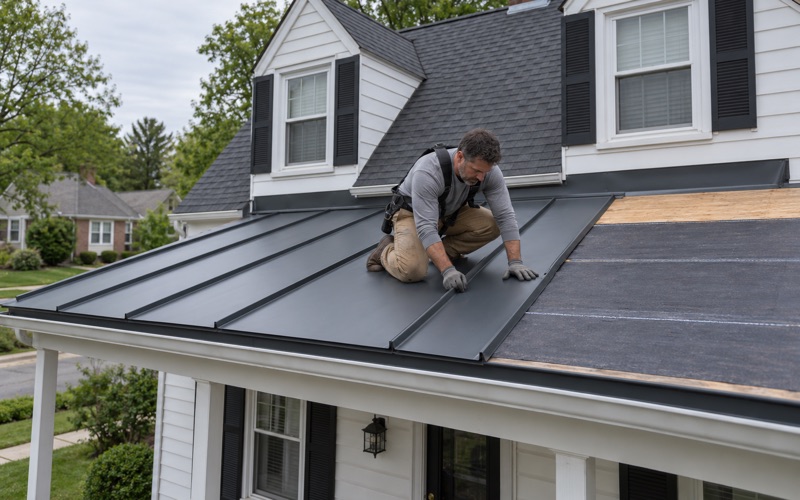
Over sound decking we install a self-adhering ice and water barrier along the eaves and a synthetic underlayment across the field. Architectural laminated shingles such as GAF Timberline HDZ, Owens Corning Duration or CertainTeed Landmark are the usual choice, with drip edge at every eave and rake. Each product line carries its own wind and impact ratings, which we list in the estimate.
Chimneys, Walls and Flashing
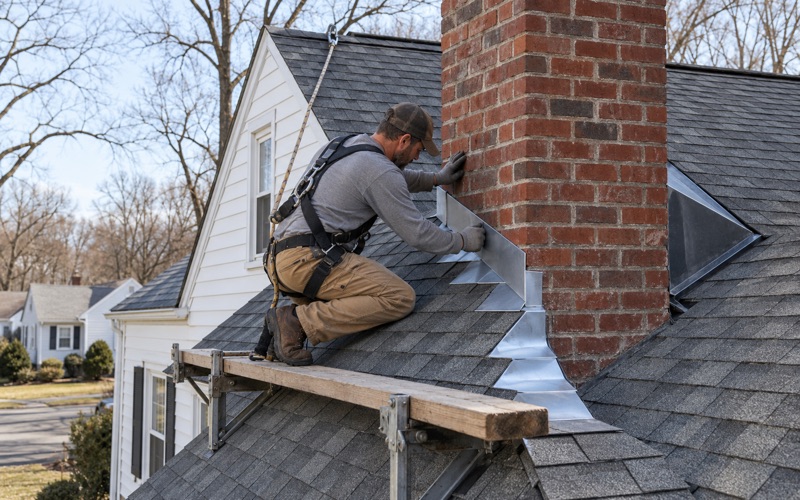
Many houses from this era have a masonry chimney and at least one wall where the roof meets siding. Those joints are where leaks most often start. We replace step flashing, counter flashing and chimney flashing along with the roof rather than reusing old metal under new shingles.
Where a wide chimney sits below the ridge, we build a cricket behind it so water and debris are diverted around it. Kick-out flashing goes in where a roof edge ends against a wall, keeping runoff out of the siding instead of letting it soak the framing below.
Ventilation and Gutters
Attics from the 1950s were not always vented with today’s shingles in mind. We check the soffit intake against the ridge vent and balance the net free area, because a hot, damp attic shortens shingle life and can void a manufacturer’s warranty. We correct the balance during the re-roof, while the ridge is already open.
Gutters and downspouts are sized and pitched as part of the same job. When the roof changes, the volume of water reaching each corner of the house may change too, and seamless aluminum gutters fitted at the same time keep that water moving toward the downspouts and away from the foundation.
Hillside Lots and the Village Square
Linglestown does not sit on flat ground. The CDP rises from about 540 feet at the village to 995 feet on the south slope of Blue Mountain, so many houses here stand on sloping lots, while the oldest blocks cluster around the square.
Working on the South Slope of Blue Mountain
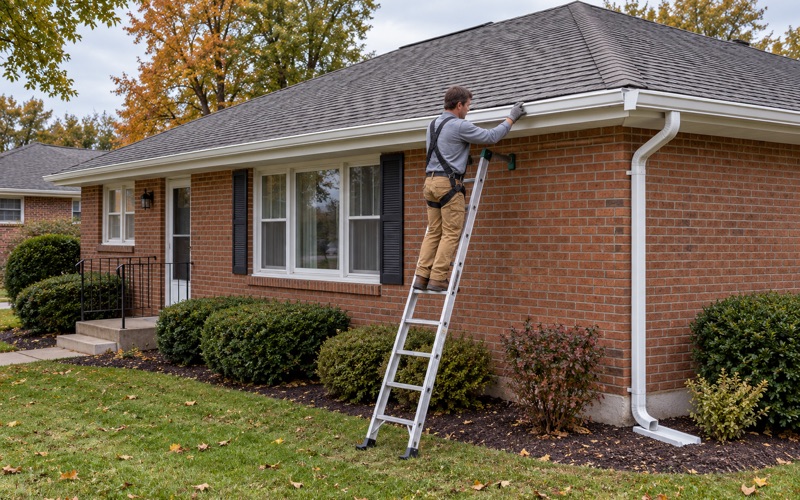
A house on a hillside lot often has a downhill side where the eave is much farther from the ground than it looks from the street. We plan ladder placement, staging and material drops around that grade before tear-off begins, and our crews follow OSHA fall protection at six feet on every residential roof.
Sloped driveways also change how we handle debris. We position the dumpster where it will not roll or block the street, and we clean the driveway, yard and gutters at the end of every work day, including a magnet sweep for roofing nails across the lawn.
Drainage on a Sloped Lot
On a hillside lot, roof water that leaves a downspout keeps traveling. If it discharges on the uphill side, it can run back toward the foundation or across a neighbor’s yard. We look at where each downspout will empty before we settle on its location.
Sometimes that means adding a downspout, moving one to a different corner or extending a run so water reaches lower ground. These are small decisions, but they are far easier to make while the roof and gutters are being planned together than as a repair afterward.
Around the Square at Linglestown Road and Colonial Road
The village center still follows Thomas Lingle’s square, and traffic there now moves through roundabouts that came out of the 2007 Linglestown Action Plan. Homes, churches and businesses share the blocks around it, and each building there gets looked at on its own terms.
Work near the square takes more coordination than a suburban street. Traffic moves steadily through the roundabouts, so we schedule deliveries and dumpster placement in advance and keep the sidewalk clear while the crew is on the roof. Neighbors on the square can expect the same end-of-day cleanup as any other job.
Planning a Re-Roof Under Lower Paxton Township
Because Linglestown is a CDP, it has no permit office of its own. Lower Paxton Township is the municipality and the permit authority for the village, so that is where our planning begins. The township office is at 425 Prince Street, Harrisburg, and it is the one we contact about a Linglestown job.
Checking the Township’s Rule First
Every township and borough around here sets its own approach to re-roof permits. Lower Paxton’s 2026 building permit application has no roofing-specific line, so we confirm with the township office how a given re-roof should be handled before we price the job.
That check takes place before the estimate, not after the contract is signed. An owner should know at the outset whether paperwork is part of the schedule, and we would rather settle that question at the kitchen table than in the driveway on tear-off morning.
Repair, Slate and Solar
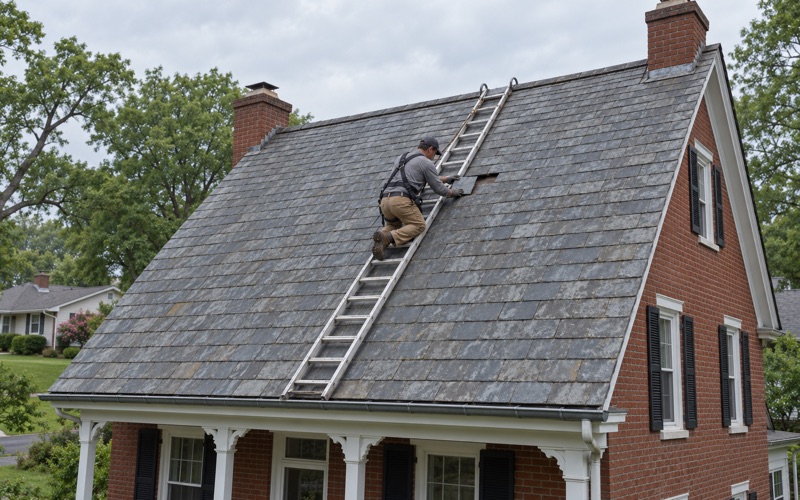
Not every Linglestown roof needs replacing. A sound slate roof gets repaired slate by slate with copper nails and slate hooks before anyone talks about tearing it off, and an asphalt roof with a single failed pipe boot gets a new boot, not a new roof. The owner hears that answer before any replacement price is mentioned.
If solar panels are mounted on the roof, we plan their removal and reinstallation as part of the schedule from the start. Finding the panels on the morning of the job is how projects stall for days, so we coordinate that step during planning.
After a Storm
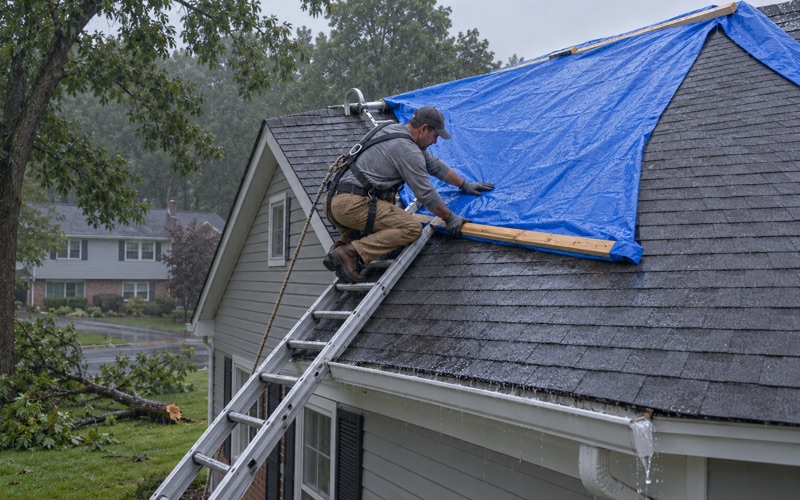
When a storm damages a roof, we photograph what we find and write it up for the owner’s own insurance claim. If the owner asks, a member of our crew will meet the adjuster on site to walk the roof and point out the damage.
We do not negotiate the claim on the owner’s behalf. Our role is to document the roof accurately, give a clear scope for the repair or replacement and then do the work once the owner decides how to proceed.
- 20+ Years Roofing
- Itemized Written Scopes
- Repair Before Replace