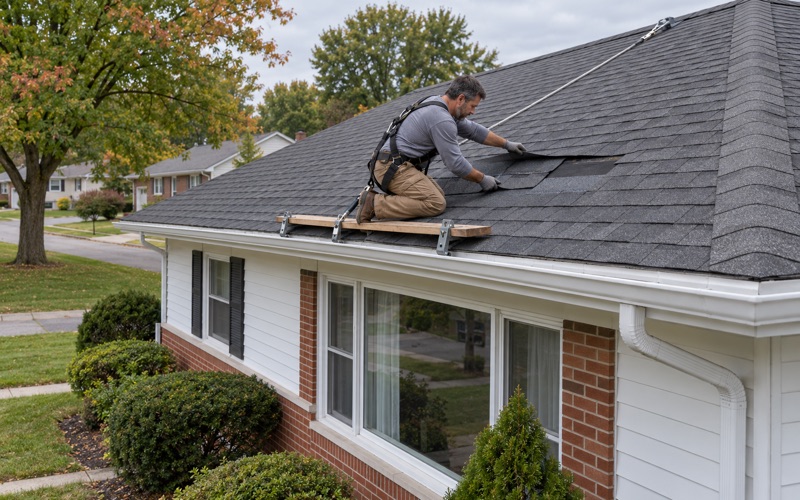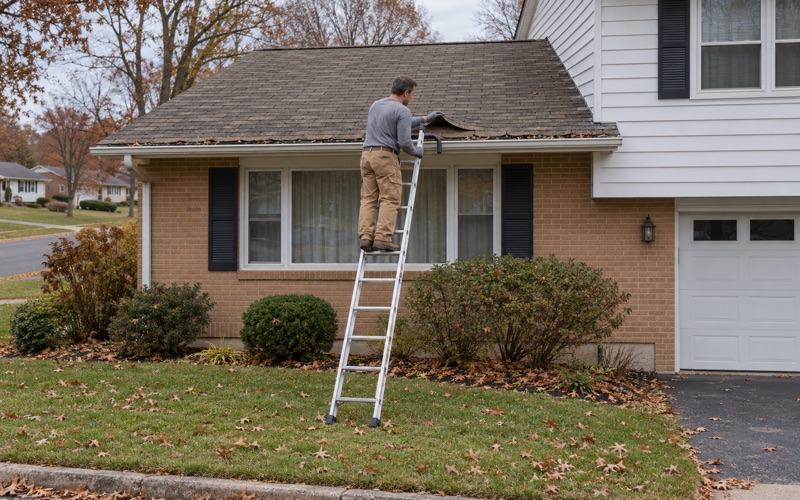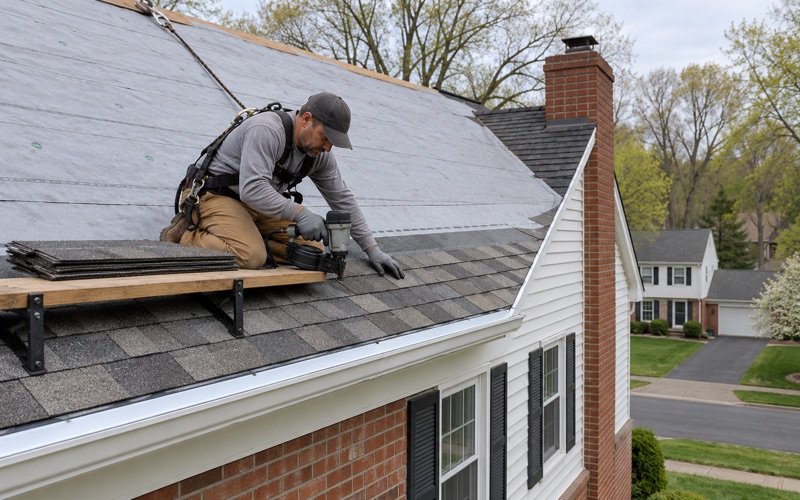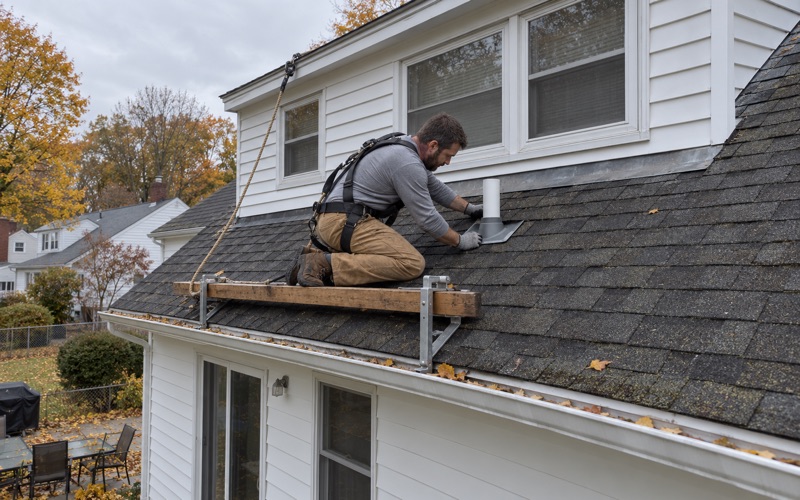
Lower Paxton Roofing has spent more than 20 years on roofing in Manheim and across our service area, and this borough asks more questions before a job starts than most homeowners expect. Two of them come from the borough itself: whether the work is a true in-kind replacement, and whether the house sits in a flood-prone area along the creek.
We sort out both before a price goes on paper. A leak call starts in the attic as well as on the shingles, so we follow the stain back to the spot where water actually enters. If the roof can be repaired, we say so plainly, and replacement only comes up when a repair would just be money spent twice.
When a full roof is the right call, our written scope breaks tear-off, decking, underlayment, flashing, ventilation and gutters into separate lines. That lets a Manheim owner hold our number beside another contractor’s and compare them item by item, rather than guessing what a single lump sum quietly leaves out.
Chiques Creek, Ordinance 691 and the Borough’s Flood Permit
The creek that draws the borough’s eastern edge
Chiques Creek forms the eastern boundary of Manheim, which puts a share of the borough’s houses closer to moving water than a hilltop street would be. For roofing, that matters less because of the water itself and more because the borough now treats work near the creek as its own permit question, separate from anything about shingles.
We start every job on that side of town by asking where the property sits relative to the mapped flood areas. We do not guess from a street name or a neighbor’s story. The borough’s own floodplain records are the place to confirm it, and we would rather spend that time up front than stop a crew halfway through a tear-off.
What Ordinance 691 changed in May 2025
On May 16, 2025, Manheim Borough adopted Flood Ordinance 691, which the borough describes as ensuring compliance with FEMA requirements for properties in mapped flood areas. Its plain-language summary is short: any work, improvements, or storage of materials in flood-prone areas requires a permit from the borough before it happens.
That last phrase is the one roofers notice. A re-roof means a dumpster, pallets of shingles and rolls of underlayment staged on the lot for days. On a property in a flood-prone area, storing those materials is part of what the borough says needs a permit, so we plan the staging and the paperwork together instead of treating delivery as an afterthought.
How the borough is watching the creek
The ordinance did not arrive alone. Manheim’s floodplain page also lists a Chiques Creek Flood Resiliency Study, a stream-improvement benefit-cost analysis and a 2023 hazard mitigation grant award notice. It points residents to live cameras on the creek north of the Old White Oak Dam and along Elizabethtown Road, plus a gauge at Hamaker Road.
For a homeowner, those cameras are a practical tool. Before a scheduled tear-off on a creek-side street, we look at the forecast and the water level together, because an open roof deck and a rising creek are a bad pairing. The borough also waived its flood permit fees through December 2025, which removed one reason to skip the step.
Looking for roofing closer to York? See York Roofing.
Roof Replacement and Manheim’s In-Kind Line
What the borough’s permit list says
Manheim Borough’s Zoning and Codes page lists the projects that need zoning or building permits, and roof replacement is on it with one qualifier: replacement projects, including roofs, siding, windows and doors, except in-kind replacements. So a new roof is not automatically permit-free here, and it is not automatically a permit job either.
That single line is the second of the two borough questions on a Manheim roof. The first depends on the creek. The second applies everywhere inside the borough limits, from one end of town to the other, and it turns on what is going onto the roof compared with what is coming off it.
Why we ask before we price
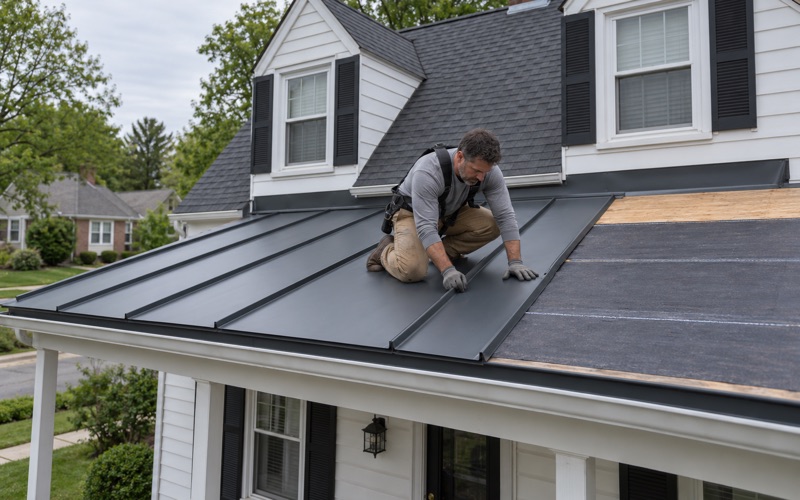
The borough’s page does not define in-kind, and we do not pretend it does. Swapping one material for another, such as an aging asphalt roof for standing seam metal, or a slate section for architectural shingles, is the kind of change worth raising with the borough before anyone signs. Guessing at the answer is how a job stalls.
Our practice is simple. Each borough and township we work in sets its own re-roofing rule, so we check Manheim’s rule for this exact house before we write the price. When the answer is not obvious from the permit list, the borough office at 60 West Colebrook Street, reachable at 717-665-2461, is the place that settles it.
When both questions land on one house
A house near the creek that is also changing roofing material carries both questions at once. It may need the zoning or building permit for a replacement that is not in-kind, and it may need the floodplain permit because the work and the stored materials sit in a flood-prone area. Neither answer stands in for the other.
We put both on the schedule before the job is priced, so the start date reflects the real permit timeline. That way a homeowner is not told one week that the roof goes on Monday and the next that the borough has questions about the dumpster. Sorting it early costs a phone call; sorting it late costs an idle crew.
East Stiegel Street and the Creek’s Flood Record
What the gauge has recorded
The National Weather Service tracks Chiques Creek at Manheim on a gauge with an action stage of 7 feet and a minor flood stage of 8 feet. Its recorded crests include 9.6 feet on September 2, 2021, still marked preliminary, and 8.16 feet on July 12, 2019. Both readings topped the minor flood line.
Those numbers describe the creek, not any one house, and we treat them that way. What they tell a roofer is that high water here is not a once-in-a-lifetime event. A roof job planned for a creek-side property in late summer deserves a weather check and a plan to button up the deck fast if the forecast turns.
July 2025 on East Stiegel Street
On July 1, 2025, floodwater from Chiques Creek covered East Stiegel Street near Wolf Street, according to a LancasterOnline photo caption from that day. Local news coverage described the borough’s flooding as a recurring problem for residents, which matches what the gauge history already shows.
For a homeowner on a street like that, flooding shapes the roof job in quieter ways. Gutters and downspouts should carry roof water away from the house and toward a sensible outlet, so we size and pitch them with the roof rather than bolting on whatever fits. Where water lands matters as much as how it leaves the roof.
Storm damage and the paperwork that follows
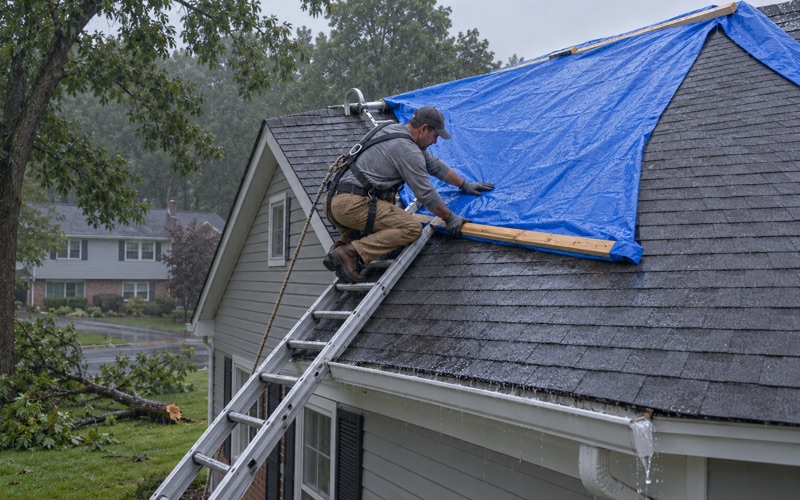
When a storm does reach the roof, we photograph what we find and write it up so the owner has a record for their own insurance claim. If asked, our crew will meet the adjuster on site and walk the damage with them. We do not negotiate the claim; that conversation belongs to the owner and their insurer.
We also keep photos from the attic side, since water that gets past flashing often shows up on rafters and sheathing first. A complete record, roof surface and underside together, gives the adjuster’s visit a clear starting point and makes the scope of the repair easier for everyone involved to follow.
Roofing Stiegel’s 1762 Town: Prewar and 1950s Houses
A borough built in two big waves
Henry William Stiegel laid out Manheim in 1762 on a tract in Rapho Township, and the borough was incorporated later, in 1838. Its housing still shows that long history. Of the 2,057 homes counted by the 2024 American Community Survey five-year estimates, 678 were built in 1939 or earlier and 649 date from the 1950s.
That leaves two large groups of roofs on very different bones. The same survey records no homes built since 2010, so most roofs we look at here sit on framing old enough to have carried earlier roofs. That history is exactly why we plan for decking and flashing surprises instead of acting shocked by them.
The prewar houses
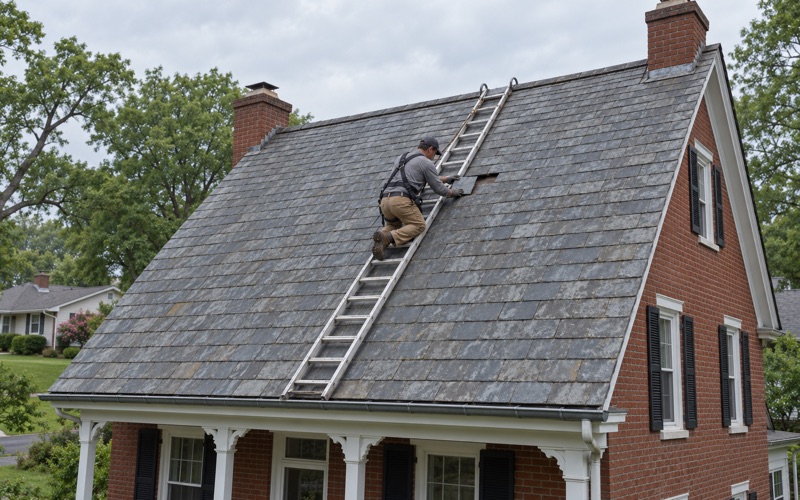
On a house built before 1940, slate is often worth saving. We repair slate one piece at a time with copper nails and slate hooks before anyone suggests tearing off a roof whose slates are still sound. Where a slate roof has truly reached its end, we explain why in plain terms and show the owner what we found.
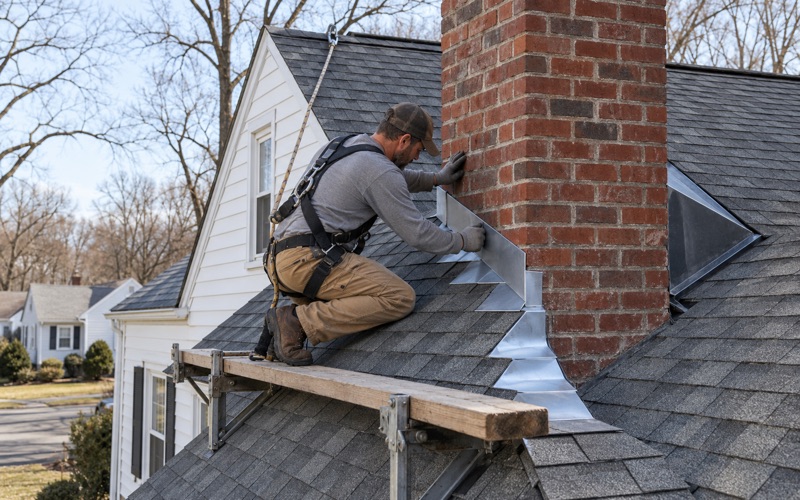
Any house built before 1978 falls under the EPA lead-safe rule when painted trim or fascia is disturbed, and we work that way on these houses. Chimneys get new step, counter and chimney flashing with the roof, set into the masonry with a reglet where needed, rather than old metal reused under new material.
The 1950s houses
Manheim’s postwar houses bring their own surprises once the old roof comes off. When the decking underneath is damaged, we photograph it and show the owner before replacing anything. The per-sheet price for that decking is written into the contract ahead of time, so the final bill holds no mystery line.
Ventilation is another thing we check closely on these homes. Many attics from that era predate ridge vents with soffit intake, so we look at the net free area the attic actually has before choosing a fix. At the end of each work day, we clean the driveway, yard and gutters and run a magnet across the lawn for stray nails.
- 20+ Years Roofing
- Itemized Written Scopes
- Repair Before Replace