Lower Paxton Roofing has spent more than 20 years on roofing in Newberry and the surrounding part of central Pennsylvania, and the first thing we bring to a house here is a habit of tracing water before pricing anything. When a homeowner calls about a leak, we go into the attic as well as onto the roof, because a stain on a bedroom ceiling rarely sits directly under the opening that let the water through.
That habit matters more on a lot near a creek, where one heavy rain tests the roof, the gutters and the ground around the foundation all at once. We give a plain answer on whether the existing roof can be repaired before a replacement ever comes up. When a full job does make sense, the written scope puts tear-off, decking, underlayment, flashing, ventilation and gutters on separate lines so you can hold it next to another estimate.
What follows covers what actually changes about the work in this corner of York County: the creek, the permit question that comes with it, the drainage at the roof edge, and the age of the houses most owners here live in. Each of those shapes how we plan a job on a Newberry house before the first shingle comes off.
Fishing Creek and the September 1, 2021 Peak
Where the creek runs
Fishing Creek runs through Newberry Township, and its water once powered the early mills at Yocumtown. The roads that follow it still carry its name, and homes along them sit close to its banks. For a roofer, that makes the creek part of the job even though nobody is working on it.
The United States Geological Survey keeps a stream gauge on the creek, listed as Fishing Creek at Goldsboro. Despite the name, the Census Geocoder places the gauge coordinates inside Newberry Township, with no incorporated place around them. The readings it records describe water moving through the township itself. The gauge is also listed with the National Weather Service as GOLP1.
What the Goldsboro gauge recorded
On September 1, 2021, the gauge recorded a stage of 10.67 feet and a flow of 6,580 cubic feet per second. The next-highest annual peak in its file came on December 18, 2023, at 1,440 cubic feet per second. That puts the 2021 flow at more than four times anything else the gauge has logged.
We want to be careful with that number. The record holds only five annual peaks, from 2020 through 2023, so it is short, and a stage is a reading at the gauge rather than a depth of water anywhere else. The National Weather Service has not set action or flood stages for this site, so there is no official category to attach to it.
What the video showed
WGAL News 8 posted video of Fishing Creek running over Yocumtown Road and West Fishing Creek Road in Etters, on a page whose address ties it to flooding from Ida. The footage shows water across the roads. It does not show roofs, and we make no claim that the creek damaged any roof here.
What the gauge and the video do show is how fast a cloudburst can overwhelm the low ground near the creek. Water a roof sheds has to go somewhere. On these lots, the path from the eave to the yard decides whether that water stays clear of the walls or joins what is already pooling.
Looking for roofing closer to Upper Allen? See Roofing in Upper Allen.
The Flood Hazard Question on a Newberry Permit
What the township application asks
The township’s residential building permit application has a floodplain section with a direct question: is the site located within an identified flood hazard area? The owner or agent then has to verify that the proposed work complies with the National Flood Insurance Program and the Pennsylvania Flood Plain Management Act, Act 166 of 1978.
The form asks the question; it does not answer it for any particular house. We have not read a flood map for each lot, so we never tell an owner whether their home sits in a flood zone. We start the job by asking it, and we send the owner to the township for the answer rather than guessing.
Checking the re-roof rule before pricing
Every township and borough we work in sets its own rule on re-roofing, and we have not found a published stance from this one. The application lists Repair as a work type, but nothing we have read says whether a re-roof needs a permit here. We confirm that with the township office on Old Trail Road before we price the job.
That call happens before the estimate, not after a crew is booked. If an application is needed, the job carries it from the start, and the owner knows the timeline before any material is ordered or any shingles come off. Owners who already know their answer to the flood hazard question can tell us at the first visit, and we will note it on the scope.
Why the question belongs on a roof job
A new roof does not change where a house sits relative to the creek, but the work around it can change where water goes. New downspout runs, a reworked splash area or an added drain line near a creekside foundation are the kinds of details worth raising with the township when the flood hazard box applies.
We would rather have that conversation early than learn halfway through that the drainage plan needs a second look. It costs nothing to ask, and it keeps the roof, the gutters and the ground work pointed at the same goal. If the answer comes back that nothing extra is needed, the job simply moves ahead on schedule.
Gutters and Downspouts on Creekside Etters Homes
Sizing gutters with the roof
We size and pitch gutters as part of the roof, never as an afterthought. On a house near Fishing Creek, that means measuring how much roof area drains to each corner, how many downspouts each run needs, and whether seamless aluminum gutters with larger outlets would carry a hard rain without spilling over the front lip.
A gutter that overflows during a cloudburst drops water straight down along the foundation, which is exactly where a creekside lot can least afford it. Getting the pitch right keeps water moving toward the outlets instead of sitting in low spots along the run and spilling at the first seam.
Moving water away from the walls
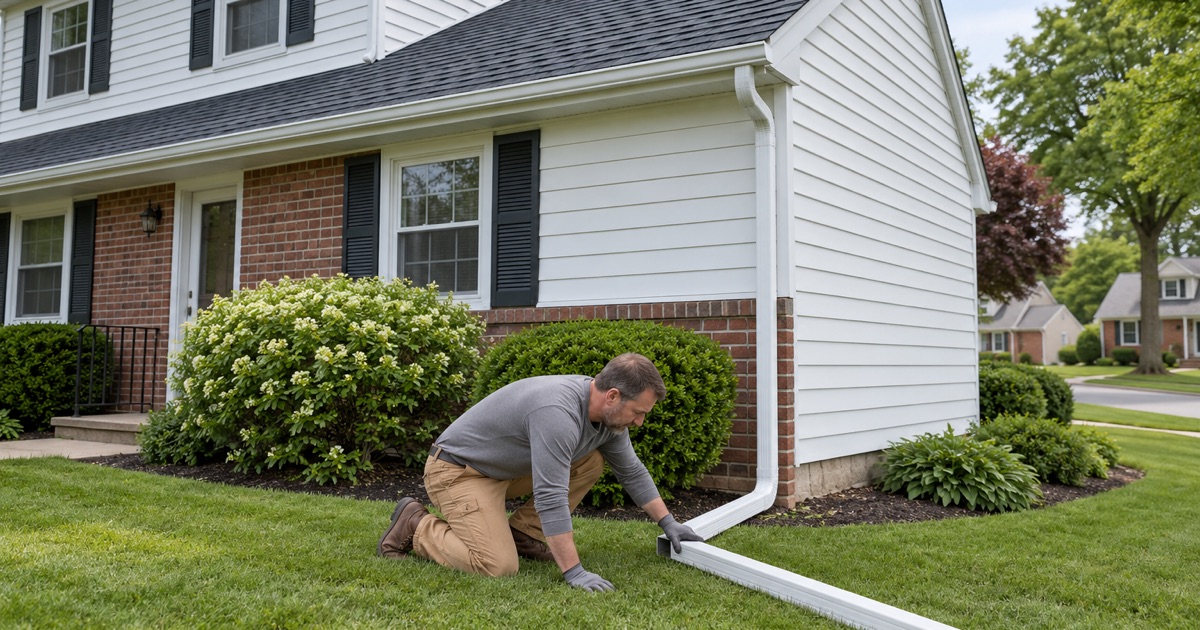
Downspouts on these homes should let out well clear of the walls. We look at where each one discharges, whether the ground slopes toward or away from the house, and whether an extension or splash block would send the water to a part of the yard that can take it. Where a downspout empties onto a walkway or driveway, we reroute it.
We do not promise that any gutter system will keep a creek out of a yard. What a well-planned system does is make sure the roof is not adding its own water to the foundation during the same storm that is raising the creek. It also keeps splashback off the lower courses of siding, where a wet wall stays wet longest.
Edges, flashing and the daily cleanup
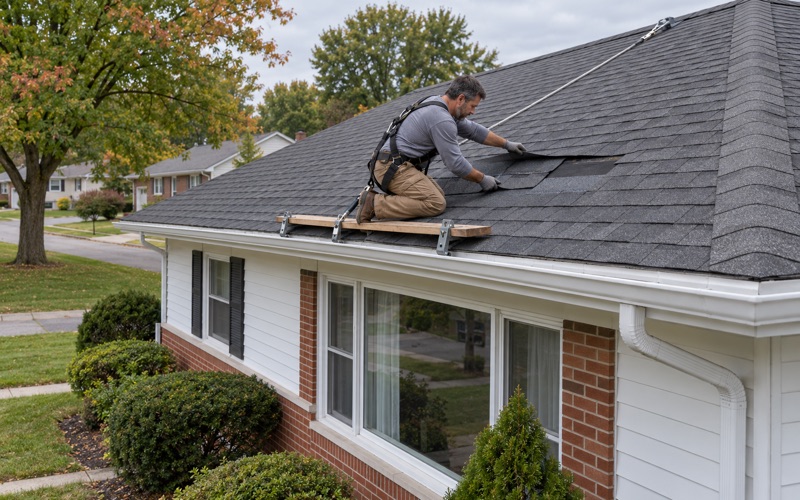
Drip edge at the eaves and rakes guides runoff into the gutter instead of behind it, and kick-out flashing at the base of a sidewall keeps water from running down the siding. We replace step, counter and chimney flashing with the roof rather than reusing old metal under new shingles.
At the end of every workday, we clean the driveway, the yard and the gutters, then run a magnet over the grass for stray nails. On a lot where water already collects near the house, leaving shingle grit in the gutters would undo the point of the job.
Newberry Houses Built From 1970 Through 1999
A township of owner-occupied homes
According to the 2024 American Community Survey, 3,693 of the 6,396 homes in Newberry Township were built between 1970 and 1999. Most are one-unit detached houses, and 94.4 percent of occupied homes are lived in by their owners, so the person calling us is usually the one who will live under the new roof.
Houses from those decades may already have been re-roofed once, and some may carry more than one layer. The International Residential Code limits reroofing under R908, so we check how many layers are on the house before we quote an overlay or a full tear-off. A third layer is not an option, so on a house that already has two, the job starts with a full tear-off.
What we find under the old roof
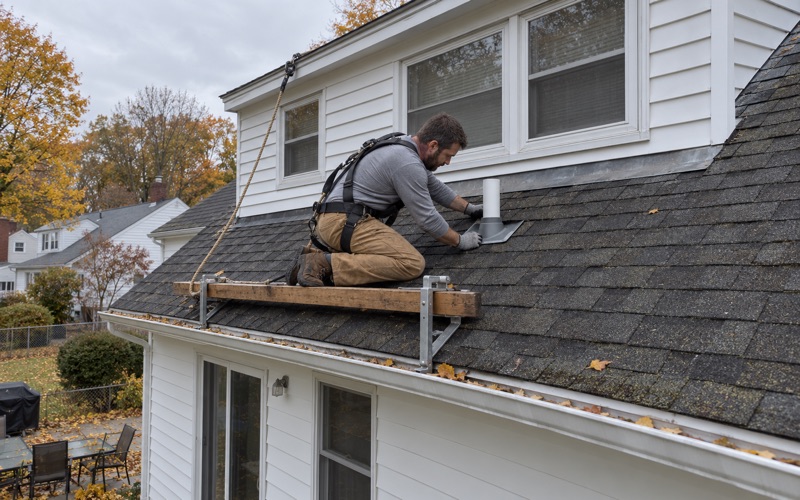
Once the old shingles are off, the decking tells its own story. When we find damaged sheathing, we photograph it and show the owner before replacing anything, at the per-sheet price written into the contract, so there is no surprise line on the final bill. Sound boards stay where they are, and the owner sees the count before the new deck goes down.
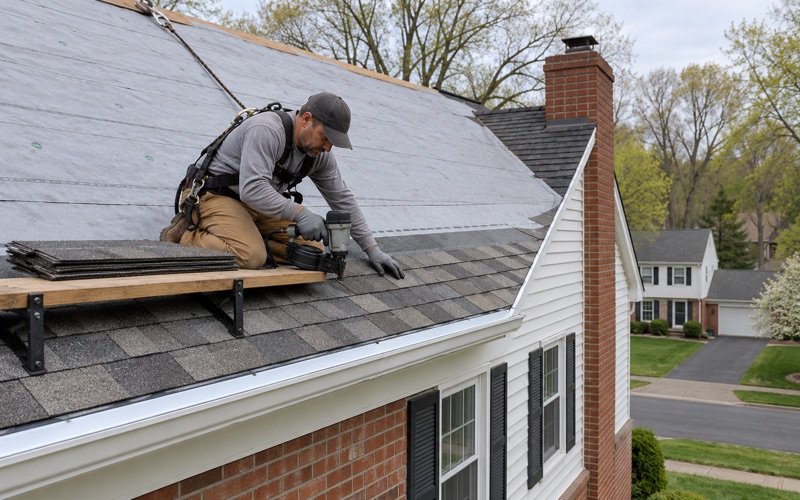
We then lay ASTM D1970 self-adhering ice and water barrier at the eaves where IRC R905.1.2 calls for it, with synthetic underlayment across the rest of the deck. Ridge vent paired with soffit intake keeps the attic moving air, which matters as much on a house of this age as the shingles do.
Choosing the next roof
Architectural shingles such as GAF Timberline HDZ, Owens Corning Duration and CertainTeed Landmark are common choices for houses from these decades, and standing seam metal suits owners planning to stay a long time. We walk through wind ratings like ASTM D3161 Class F and impact ratings like UL 2218 Class 4 so the comparison is about performance, not just color.
If a storm does damage the roof, we photograph it and write it up for the owner’s own insurance claim, and we will meet the adjuster on site when asked. We do not negotiate the claim; that stays between the owner and the insurer. Owners get the photos and the written notes to keep, whatever they decide to do next.
- 20+ Years Roofing
- Itemized Written Scopes
- Repair Before Replace