
Lower Paxton Roofing has handled roof repair in Lower Paxton, PA for more than 20 years, serving surrounding cities including Linglestown, Progress, Susquehanna Township, Harrisburg and Hummelstown. Most calls start with a drip, a stain or a missing shingle, and most of them end with a repair rather than a new roof.
We repair what is actually failing. That means looking in the attic before we price anything, because water travels along rafters and sheathing and rarely shows up directly under the hole. Once we know where it gets in, we write down what we will fix, what it costs and how long we expect the repair to hold. This page covers the repairs we do on pitched and low-slope roofs, how a repair visit runs, and the point at which repair stops being the sensible answer.
Residential Roof Repair on Pitched Roofs
Shingle Repairs and Wind Damage
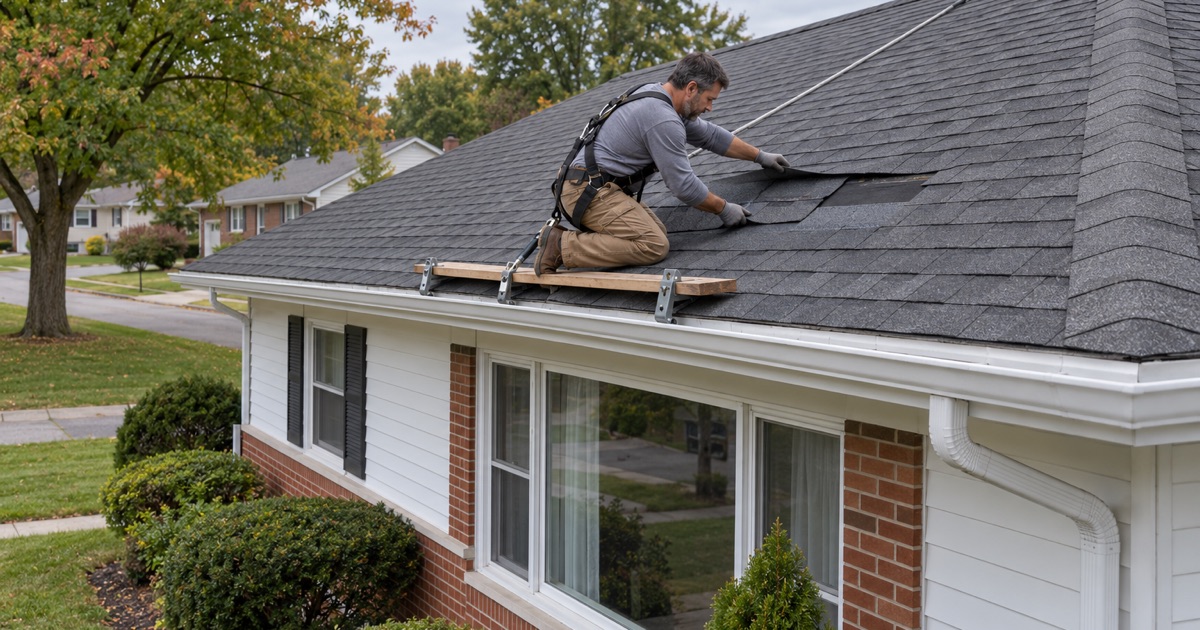
Missing tabs, creased shingles and lifted edges are the most common repairs we make on asphalt roofs. Wind usually breaks a shingle along its sealant strip, and once one goes, the ones beside it are exposed. We replace damaged shingles with the closest available match, hand-seal the surrounding courses, and check that the nails underneath are set correctly rather than just covering the gap.
We also look at why the shingle failed. A shingle that never sealed because it was installed in cold weather, or one nailed too high, will keep failing in the next storm. Where that pattern runs across the roof, we say so, because a repair that ignores the cause tends to bring us back to the same spot.
Flashing Repairs at Walls and Chimneys
Flashing fails long before shingles do on many roofs. Step flashing along a sidewall, counter flashing on a chimney and apron flashing where a lower roof meets a wall all let water in once they loosen or rust. We replace damaged flashing with new metal, cut counter flashing into the mortar joint or a reglet, and never rely on a bead of caulk to do flashing’s job.
Where a roof line dumps water against a wall, a kick-out flashing at the bottom of the run sends that water into the gutter instead of behind the siding. It is a small part that many older roofs never had, and adding it during a repair can stop rot that has been building inside the wall for years.
Pipe Boots, Vents and Skylights
Rubber pipe boots crack in the sun, and a cracked boot lets water straight down the vent pipe into the attic. We replace them with new rubber boots or lead flashing boots that last longer. Exhaust vents, box vents and old turbine vents get the same attention, with new flashing and properly lapped shingles around each.
Skylights leak at the curb or at the seal between the glass and the frame. We check which it is before deciding whether to reflash the skylight or recommend replacing the unit itself. Reflashing a skylight whose seal has failed only moves the leak a few inches, so the diagnosis decides the price.
Slate and Low-Slope Roof Repair
Slate Roof Repairs
A slate roof in good overall condition is worth repairing, not replacing. Broken, slipped or missing slates are replaced one at a time, secured with copper nails and slate hooks so the new piece sits flat without breaking its neighbors. We match the slate’s size, thickness and color as closely as available stock allows.
Walking a slate roof the wrong way does more damage than most storms, so we work from ladders, hooks and roof brackets rather than walking across the field. Flashing on slate roofs is usually copper or lead-coated, and when it fails we replace it in kind so the repair lasts as long as the slate around it.
Membrane Repairs on EPDM, TPO and Modified Bitumen
Porch roofs, rear additions, garages and commercial buildings often carry low-slope membranes that need a different repair entirely. EPDM rubber is patched with compatible seam tape and primer, TPO and PVC single-ply membranes are heat-welded, and torch-down SBS or APP modified bitumen is patched with fused cap sheet. Mixing systems is how a patch peels back off.
The weak points on low-slope roofs are seams, edges and the places where the membrane turns up a wall. We probe those first, check for wet insulation below a blister, and tell you if water has spread under the membrane farther than the visible damage suggests.
Commercial Roof Repair
On commercial and multifamily buildings, most repairs involve curbs around rooftop units, roof drains, scuppers and parapet flashing. We repair the membrane and flashing around each penetration and clear drains so water leaves the roof rather than ponding. We document each repair with photos and a written scope so a property manager can report back to an owner without climbing the roof.
How a Roof Repair Visit Runs
Attic First, Then the Roof
We start inside. Staining on the underside of the deck, damp insulation, rusted nail tips and daylight around penetrations tell us where water and air are moving. Then we go onto the roof and match what we saw inside to what we find outside. That order is what lets us price the actual source of a leak rather than the spot on the ceiling.
If the attic shows frost or condensation instead of a roof leak, the repair may be ventilation or air sealing rather than roofing. We would rather tell you that than sell a shingle repair that leaves the real problem in place.
A Written Repair Scope
Before any work, you get a written scope that names each repair, the materials and the price. If we find something we did not expect once work starts, such as soft decking under a damaged section, we photograph it and show you before anything extra is done, at a per-sheet decking price already in the agreement.
Permits on a Repair
Pennsylvania’s Uniform Construction Code excludes repairs to residential buildings unless a local ordinance requires otherwise, under 34 Pa. Code 403.1(b)(9). Lower Paxton Township’s own chart says a roof needs a building permit only for structural changes. Neighboring municipalities set their own rules, so we check the rule for the address before we schedule.
When Repair Stops Making Sense
Signs a Roof Is Past Repair
Widespread granule loss, shingles curling at the edges, several soft spots in the decking and repeated leaks in different places all point toward a roof that has reached the end of its life. Repairing one spot on a roof like that is money spent where the next leak is already forming.
We do not use those signs as a sales line. If a repair will hold for several more years, we say so and price it. If it will not, we explain why and leave the decision to you, with the reasons in writing.
Layers and the Two-Layer Limit
Many houses here are on their second or third roof covering, and some still carry a layer installed over an older one. IRC R908 limits asphalt roofs to two layers, so a roof that already has two cannot take a third. A repair on a two-layer roof is possible, but it is harder to make watertight because the new shingles sit on an uneven base.
When we find two layers during a repair, we note it on the scope. It does not force a replacement today, but it does mean the next roof will be a full tear-off, and that cost belongs in an owner’s planning rather than arriving as a surprise later.
Repairs Before Selling a House
Pennsylvania sellers disclose known roof problems on the seller property disclosure statement, and a buyer’s inspector will look for stains, soft decking and patched flashing. A repair done properly, with photos and a written description of what was fixed, answers those questions directly and keeps a small roof issue from turning into a negotiation.
We give every repair customer that paperwork as a matter of course. For a seller, it shows the problem was diagnosed at its source and fixed with proper materials, rather than covered with roofing cement the week before the listing went live.
- 20+ Years Roofing
- Itemized Written Scopes
- Repair Before Replace