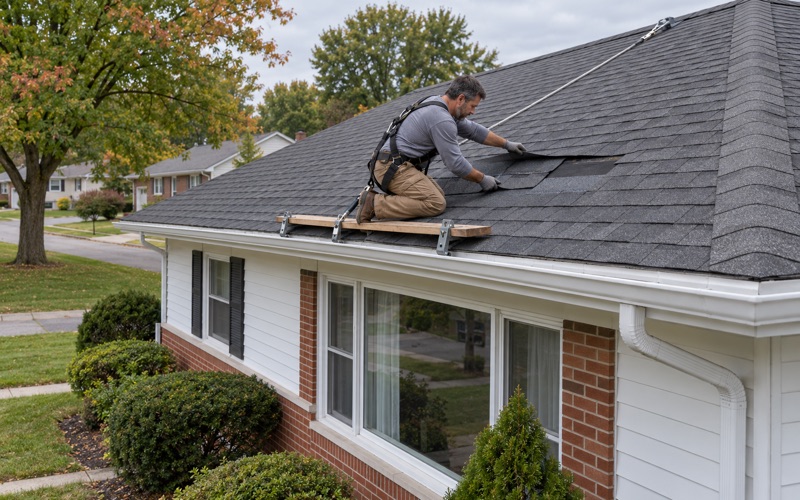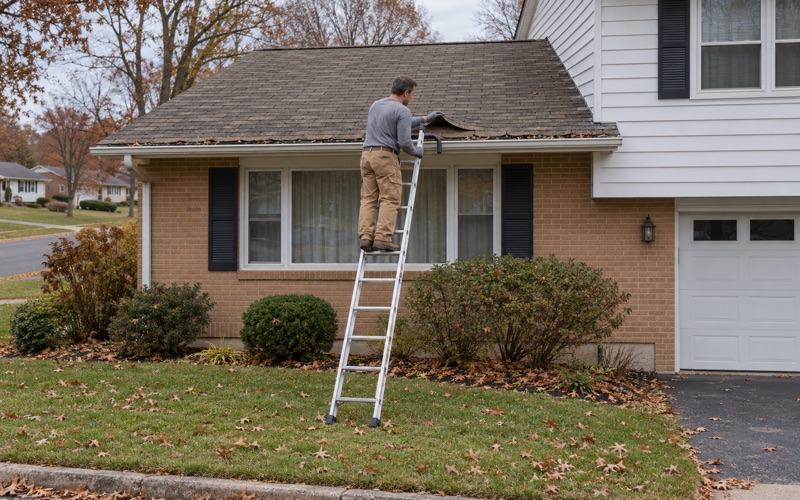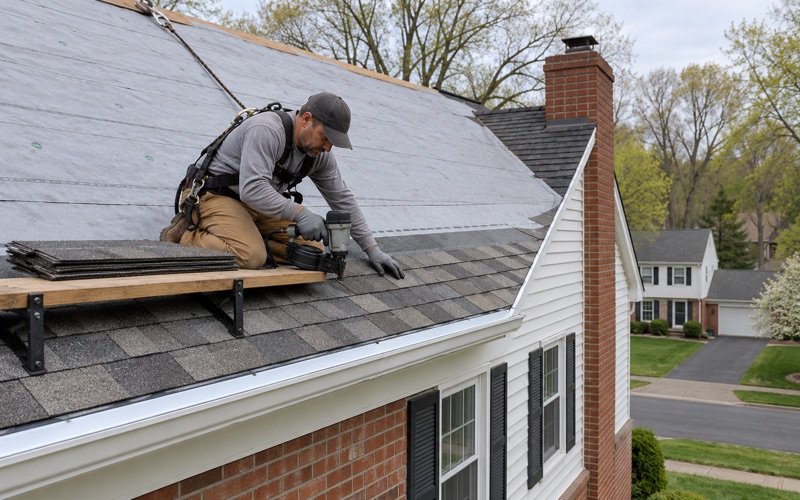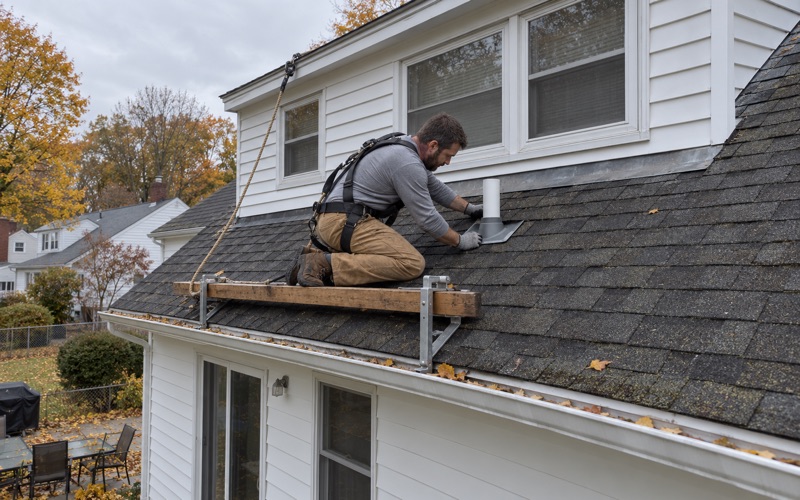
Lower Paxton Roofing brings more than 20 years of experience to roofing in Springettsbury, whether the building is a split-level with a worn ridge or a long, low commercial structure off a busy road. We start by finding out what is actually wrong. On a leak call, that means going into the attic as well as onto the roof, so the water is traced to its real entry point before anyone writes a price.
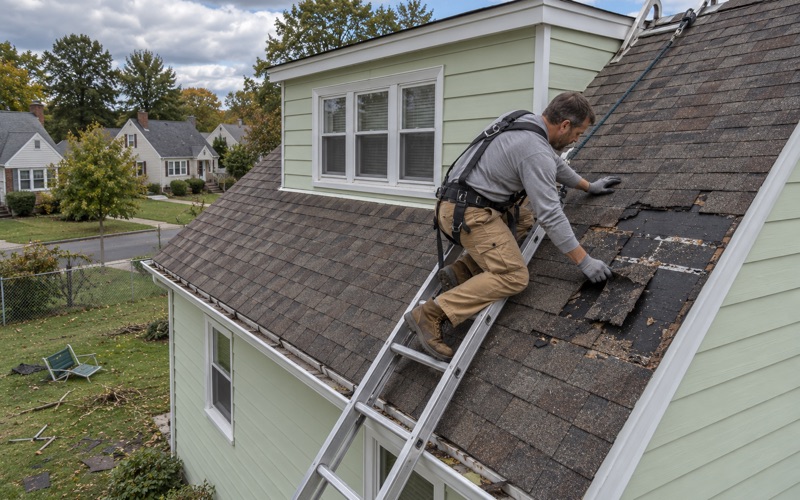
Our first answer is always about repair. If a roof has years left and the trouble is a cracked pipe boot or a lifted run of shingles, we say so plainly before replacement comes up at all. When replacement is the right call, the written scope breaks tear-off, decking, underlayment, flashing, ventilation and gutters into separate lines, so an owner holding two estimates can compare them item by item.
The township matters to that scope as well. Each municipality we work in handles re-roof permits its own way, and we check the rule for the property’s own township before the job is priced rather than after the crew arrives.
Eden Road’s Industrial Buildings and the Harley-Davidson Plant

A plant that started as a Navy contract
Springettsbury Township holds some of the largest industrial buildings in York County, and the best known sits on Eden Road. Harley-Davidson’s own archives say the first facility was built under a 1941 contract between the United States Navy and York Safe & Lock Co. American Machine & Foundry later bought the site from the Navy.
At one time the York operation spread across 41 separate buildings that took up 1.5 million square feet. Today, the archives say, it comprises only two buildings that together total 650,000 square feet. That contraction is a useful reminder that a big industrial site changes shape over decades, and the roofs on it change along with it.
Building area is not roof area
Those square-foot figures describe buildings, not roofs, and we are careful never to treat them as one number. Floor area counts every story, mezzanine and enclosed level. Roof area depends on footprint, parapets, overhangs and rooftop equipment, none of which shows up in a published building total.
So when an owner or facility manager asks us about a large building in Springettsbury, we start from drawings or a measured survey, not a headline figure. We would rather spend a morning on the roof with a tape and a moisture meter than price a membrane from a newspaper article.
What large low-slope roofs usually involve
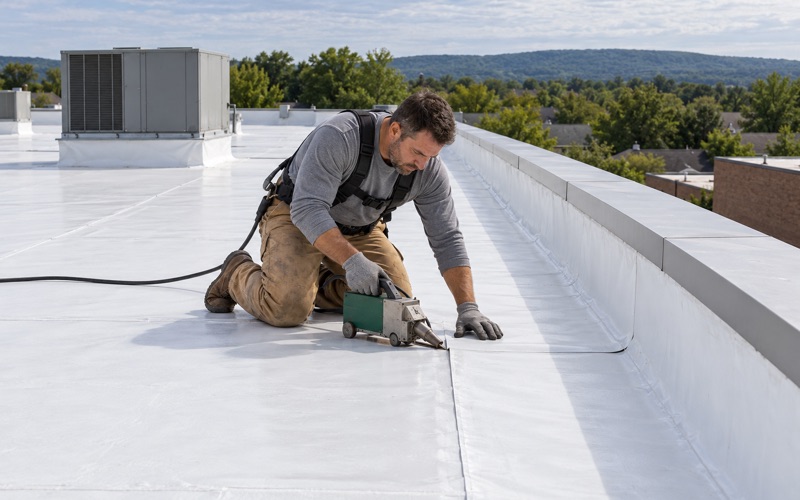
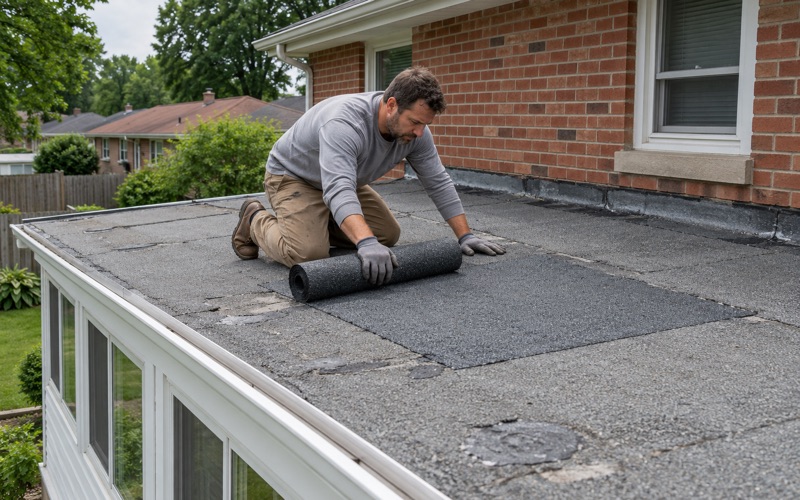
Commercial and industrial buildings generally sit under low-slope systems. Across the trade, those include EPDM rubber membrane, TPO and PVC single-ply membranes, and torch-down SBS and APP modified bitumen, each with its own seam method and its own flashing details at curbs, drains and parapets.
We do not assume which system any particular Eden Road building carries. We look, take cores where the owner allows, and write down what is actually there. That finding drives every other decision, from whether a section can be patched to how the edge metal and wall flashing get detailed.
Looking for roofing closer to Manheim? See Roofing Services in Manheim.
The Eden Road Logistics Center and Warehouse Roofs
From West Campus to distribution center
Next door to the motorcycle plant, the former Harley-Davidson West Campus has become the Eden Road Logistics Center. The 58-acre site along Route 30 was built out by York-based Stewart & Tate Construction for NorthPoint Development, and reports put the distribution center at about 750,000 square feet.
Post Consumer Brands is the main tenant, planning to use most of the building for dry cereal storage. A warehouse of that size is a different roofing problem from a house: long drainage runs, many penetrations, and a tenant whose stored goods cannot get wet.
Why warehouse leaks need tracing, not guessing
On a big low-slope roof, water can travel a long way across the deck or insulation before it shows up inside. The drip over a pallet rack is rarely directly below the opening. That is why our leak calls look from underneath as well as from above, matching stains and wet insulation to the roof surface before anything is priced.
For a warehouse owner, that tracing step protects inventory as much as the roof. A patch placed over the wrong seam costs a service call and leaves the real opening working. A patch placed over the right one, confirmed from inside, is usually the cheapest repair the building will ever get.
Drainage and gutters at warehouse scale
Large buildings shed water through interior drains, scuppers, or perimeter gutters and downspouts. Whatever the arrangement, we size and pitch the drainage with the roof rather than treating it as a separate afterthought, because a roof that sheds water into an undersized gutter has only moved the leak somewhere else.
At the end of each work day we clean the site, gutters included, and run a magnet sweep for roofing nails. On a commercial property with truck courts and employee parking, a single stray nail turns into a flat tire the owner hears about by lunchtime.
What Springettsbury’s Permit List Names, and What It Leaves Out
The list on the township’s page
Springettsbury Township Community Development handles building permits from the Municipal Complex at 1501 Mount Zion Road, and the office can be reached at (717) 757-3521. The township’s Building Permits page lists permits as required for new building construction, plumbing, mechanical and electrical work, signage, taller retaining walls, raised or roofed decks and porches, and swimming pools.
Roofing does not appear on that list. The township’s FAQ names interior alterations without structural or egress changes, carpet, painting, wallpapering and landscaping as work that needs no permit, and it says nothing about roofing either way.
Silence is a question, not an answer
We do not read that silence as an exemption, and we do not read it as a requirement. A list that leaves roofing out simply leaves the question open, and the answer can depend on what the job involves: a straight tear-off and replacement, structural decking work, a new roof over a porch, or changes to a large commercial building.
So before we price a Springettsbury roof, we confirm the permit question with Community Development for that specific scope. For owners of industrial or warehouse roofs, where the work is larger and often touches rooftop equipment or structural members, that call belongs at the start of planning, not after the first section is open.
Putting the answer on the scope
Whatever the township tells us goes into the written scope, so the owner can see whether a permit is part of the job and who is pulling it. Every other line stays separate too, with tear-off, decking, underlayment, flashing, ventilation and gutters each priced on its own.
If damaged decking turns up once the old roof is off, we photograph it and show the owner before replacing anything. The per-sheet price is already set in the contract, so a surprise under the shingles does not become a surprise on the invoice.
Springettsbury’s 1950s and 1960s Neighborhoods
Where most of the homes come from
Away from Eden Road, Springettsbury is mostly a township of houses. Census estimates count 2,079 homes built during the 1950s and 1,857 during the 1960s, and 6,387 of the 10,202 occupied homes are owner-occupied single-family detached houses. The township takes in East York, Pleasureville, Yorklyn and Stonybrook.
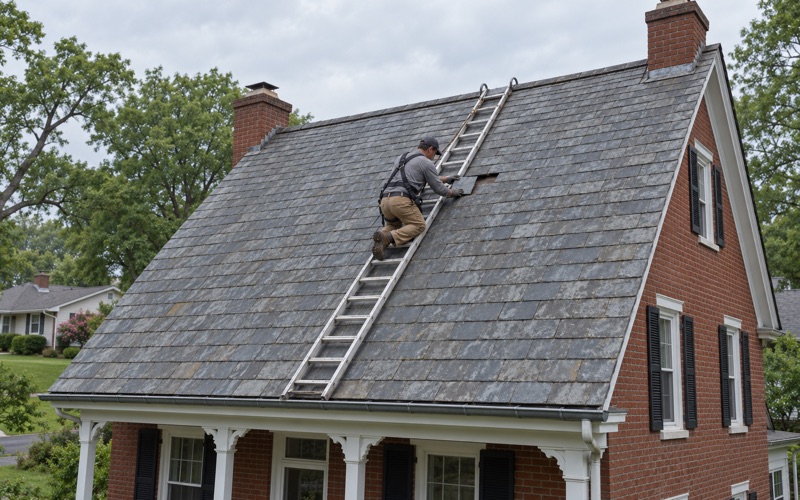
Houses from that era have often been reroofed more than once by now. That history is the first thing we check, because the number of layers already on the deck shapes the job. The IRC R908 reroofing rules set a two-layer limit, so a house already carrying two layers calls for a tear-off, not an overlay.
Flashing, ventilation and the details older roofs hide
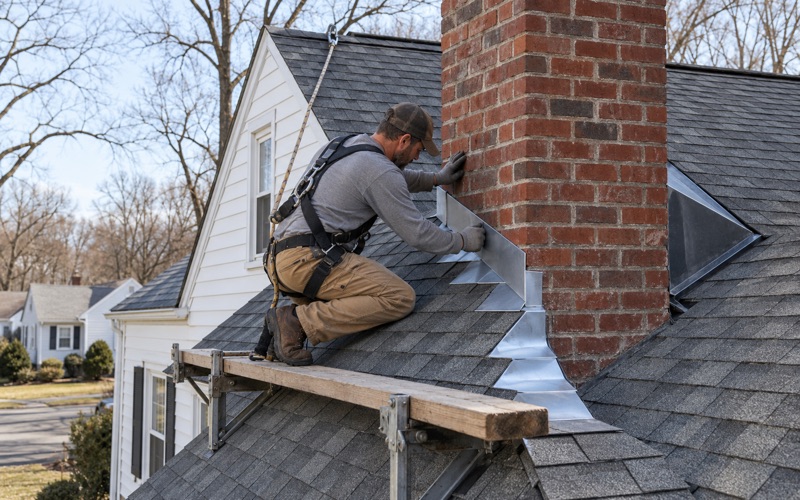
Mid-century houses tend to have modest attics, chimneys at the ridge or gable, and ventilation that was barely considered when they were built. When we replace a roof here, step, counter and chimney flashing are replaced with it rather than reused under new shingles, and a chimney wide enough to dam water gets a cricket.
Ventilation gets the same attention. We pair ridge vent with soffit intake and work out the net free area, because a well-shingled roof over a hot, damp attic still ages early. For the shingles themselves, architectural laminated products such as GAF Timberline HDZ, Owens Corning Duration or CertainTeed Landmark suit houses of this age well.
Storm damage, solar panels and the last day of the job
After a storm, we photograph and write up the damage for the owner’s own claim, and we will meet the insurance adjuster on site when asked. We document what the roof shows; we do not negotiate the claim on the owner’s behalf.
If a Springettsbury home has solar panels, their removal and reinstall go into the schedule from the start rather than being discovered on the day the crew shows up. And the job ends the way each day of it did, with the driveway and yard picked clean before we pull away.
- 20+ Years Roofing
- Itemized Written Scopes
- Repair Before Replace