Lower Paxton Roofing brings more than 20 years of work to roofing in Steelton, where the house you own is usually one link in a longer roofline. When a section of that line leaks or wears out, the job is not only about your shingles. It is about the edges where your roof hands off to the roofs on either side.
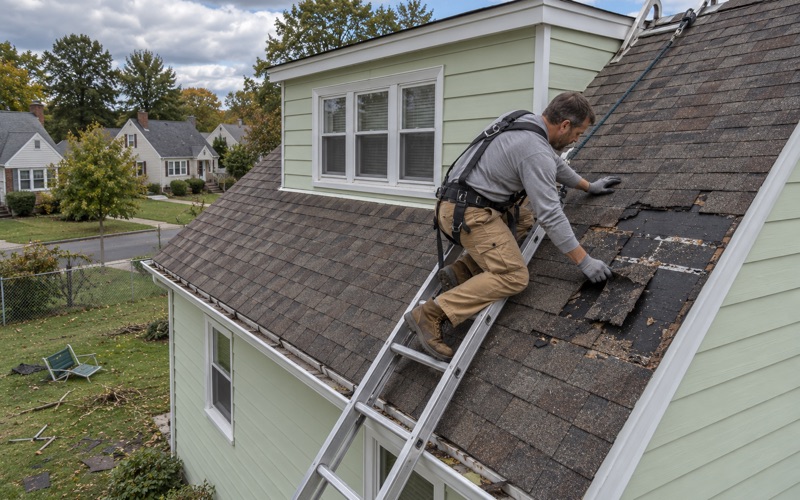
We start every leak call in the attic as well as on the roof, because water in a row house can travel sideways before it shows on a ceiling. Only after we find where it actually enters do we put a number on the repair. If the roof can be fixed, we tell you that plainly before replacement comes up at all.
When replacement is the right call, our written scope breaks the work into separate lines: tear-off, decking, underlayment, flashing, ventilation and gutters. That lets you set our estimate beside anyone else’s and compare them item by item, which matters on a narrow attached house where one missed line item, like the flashing at the shared edge, can decide whether the new roof stays dry.
A Borough That Grew Around the First All-Steel Mill
Chosen in 1866, Running by 1868
Steelton exists because of the steel mill. The Pennsylvania Steel Company chose this stretch of the Susquehanna River for its works in 1866, and the mill began operation on May 15, 1868. The place was first called Baldwin, took the name Steelton in 1879 and was incorporated as a borough on January 19, 1880.
The borough’s own history calls the Steelton plant the first mill in the United States dedicated exclusively to the process of making steel. The works later passed to Bethlehem Steel, then ArcelorMittal, and today Cleveland-Cliffs operates it. As the plant expanded, more houses, stores and churches went up around it, which is how the borough came by the dense housing it still has.
Attached Rows: 1,440 of 2,629 Homes
The mill drew workers from England, Ireland, Germany, Italy, Eastern Europe and Mexico, along with Black families moving north from the South. At its peak, the borough says, Steelton was home to over 16,000 residents representing 33 different ethnic groups, and those groups settled in different sections of town. The 2020 census counted 6,263 people.
A town that grew that quickly around one employer filled in densely, and the housing count still shows it. Census figures put 1,440 of Steelton’s 2,629 homes in the one-unit attached category, about 54.8%, and 1,023 homes, or 38.9%, date from 1939 or earlier. Attached houses are the most common home in the borough, outnumbering detached ones nearly two to one.
Looking for roofing closer to Lower Swatara? See Roofing in Lower Swatara.
Re-Roofing One House in a Continuous Row
Your Roof Is One Section of a Longer Line
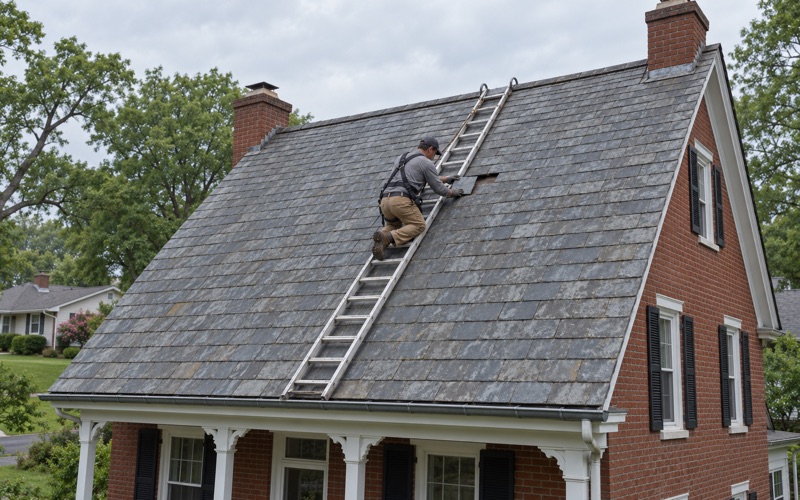
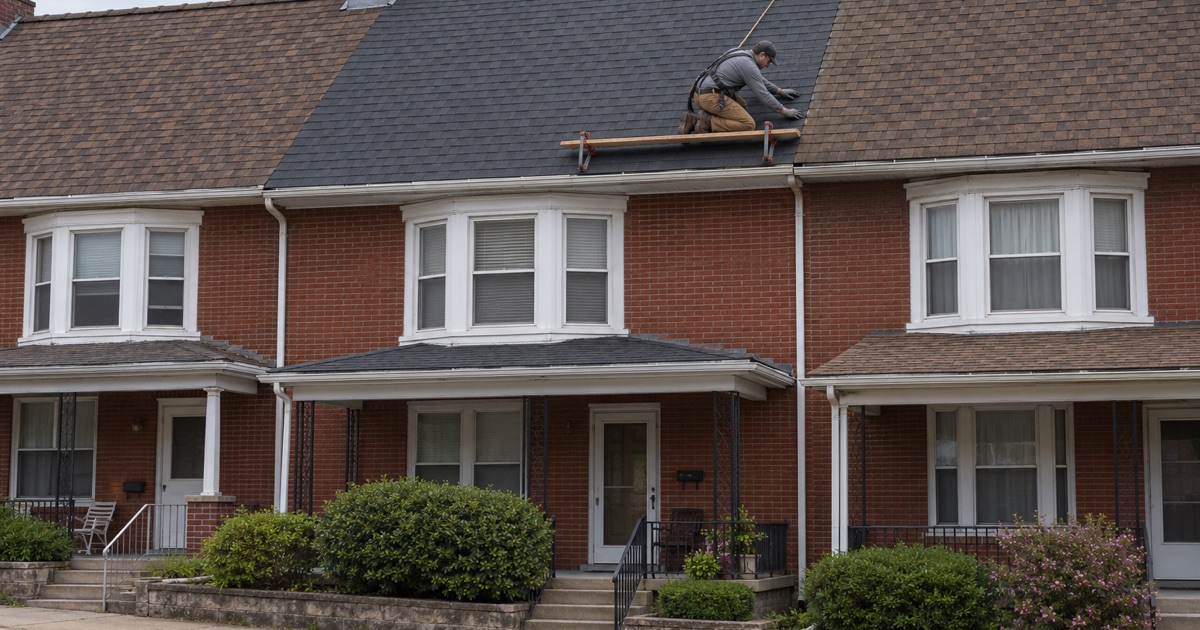
On a row of attached houses, each owner’s roof is a section of one continuous surface, split at the party walls. When we replace yours, the neighbors’ sections stay exactly as they are, whatever their age or material. Our job is to take off and rebuild only your section while leaving the roofs on both sides undisturbed and watertight.
That means planning the tear-off from the edges inward. We cut the old material cleanly at the line between houses rather than pulling it up in sheets that would lift the neighbor’s shingles or membrane. If your house sits at the end of the row, one side is open and the other is shared, so the two edges get different details.
Matching Pitch, Height and Material at the Seam
Neighboring sections may have been roofed at different times with different products, so the surface we tie into may be older shingles, a rolled roof or a low-slope membrane. We match the new roof’s finished height as closely as the layers allow, because a step up or down at the seam creates a ledge where water and debris collect.
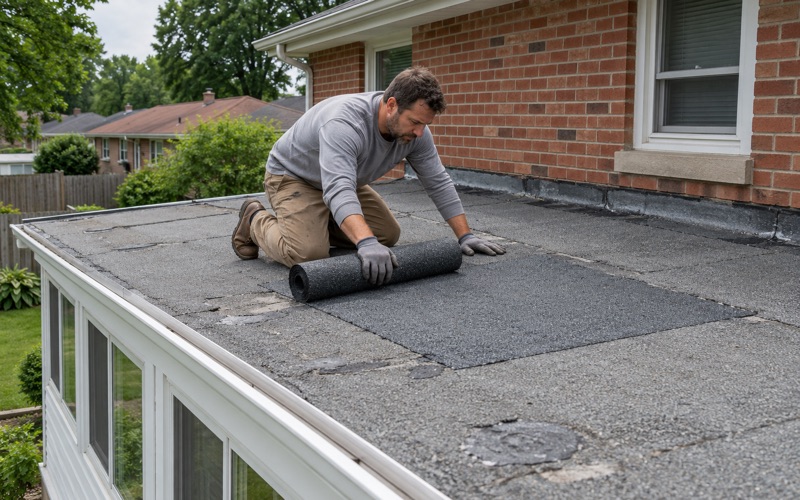
Where the rear of a row steps down to a flatter roof over a kitchen or porch, the material often changes too. On those low-slope runs we use EPDM rubber membrane or a modified bitumen system rather than shingles, and we carry the transition to your neighbor’s section with flashing, not a bead of sealant that will crack within a few seasons.
Decking, Layers and What We Find Underneath
On a Steelton row house, the boards under the roof can hide surprises once the old layers come off. Any damaged decking we find is photographed and shown to you before we replace it, and the per-sheet price is already written into the contract. You see the problem and know the cost before a single new sheet goes down.
We also count the layers already on your section. Building codes limit how many roof coverings can be stacked, and a row house re-roofed twice over the decades may need a full tear-off to the boards. We check the layer count at both party walls, since the neighbors’ history can leave extra material lapped over the edge of yours.
Where Your Roof Meets the Neighbor’s at the Party Wall
Why the Party Wall Seam Leaks
The party wall is the masonry or framed wall your house shares with the one next door, and on top of it the two roofs meet. That joint is a common starting point for row-house leaks, because water reaching it can run down inside the wall and show up in a room well away from the actual opening.
This is where our attic-first inspection earns its keep. From inside, we can see whether staining follows the party wall, whether daylight shows along the seam, and whether the leak is yours or is crossing over from the neighbor’s side. Pricing a new roof for a leak that starts next door would not solve anything, so we find the source first.
Flashing the Seam Instead of Caulking It
Where your new roof ends at the party wall, we build a real transition instead of relying on tar or caulk. Depending on how the two roofs meet, that can mean a raised cap over the wall, step flashing and counter flashing where one roof sits higher, or a membrane strip lapped onto both sections and sealed to each.
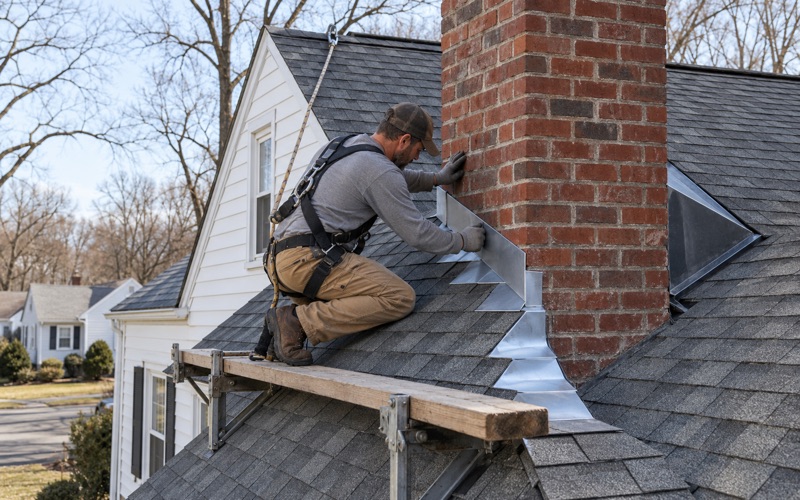
Old flashing is never reused under the new material. Step, counter and chimney flashing come out with the old roof and go back new, and that includes the shared chimneys that can straddle the line between two row houses. Where a chimney is wide enough to trap water on its uphill side, we add a cricket to split the flow around it.
Talking With the House Next Door
Both houses depend on the party wall, even though only your section is being replaced. Before tear-off we suggest telling the neighbors when the crew is coming, since we will be working right at their edge. A short conversation ahead of time heads off surprises, and we keep our work on your side of the line.
Working this close to the house next door makes cleanup matter more. At the end of every work day we clean the sidewalk, yard and gutters, including a magnet sweep for roofing nails, and we check that nothing has landed on the neighbors’ roofs or in their gutters. Your gutters and downspouts are sized and pitched as part of the roof, not as an afterthought.
Filing With the Steelton Codes Department on Front Street
The Office at 123 North Front Street
Residential permits in the borough go through the Steelton Codes Department on the third floor of the Frederick Douglas Municipal Building at 123 North Front Street. The department’s permits page says a permit must be submitted in person, so the paperwork is a trip to that office rather than an upload. Commercial permits are handled separately through Commonwealth Code Inspection Services.
The borough’s permits page does not publish a roofing-specific rule, which is exactly why we check before pricing rather than assuming. Every township and borough we work in sets its own approach to re-roof permits, and what applies in Lower Paxton says nothing about what applies here. We confirm the Steelton requirement for your address, then build it into the estimate.
What the Borough’s Application Asks For
The residential application lists repair and replacement among its improvement types and asks for the contractor’s Pennsylvania home improvement registration number. We fill in our own details on that form and bring what the office needs, so you are not left translating contractor paperwork. The FAQ also notes that residential applications are to be approved within 15 business days.
That window matters for scheduling. If a permit is needed, we plan the start date around it so the old roof does not come off while paperwork is still pending, and a house sharing walls with two neighbors is never left half-open. Rooftop solar on a row-house section is scheduled the same way, with panel removal and reinstall planned from the start.
Storm Damage on a Shared Roofline
When wind or hail damages a row, several neighbors may call at once, and each claim covers only its own section. We photograph and write up the damage to your section for your own claim, and we will meet your insurance adjuster on site if you ask. We do not negotiate the claim; we document what is on the roof.
On a party wall seam, the photos show both sides of the line so the adjuster can see where your section ends. If the damage is minor and the roof is sound, we say so and quote the repair. Replacement only enters the conversation when a repair would not hold, and that is the same answer we give whether or not insurance is involved.
- 20+ Years Roofing
- Itemized Written Scopes
- Repair Before Replace